


Conveyorized Metal Detector Integration: Food Line Setup Guide
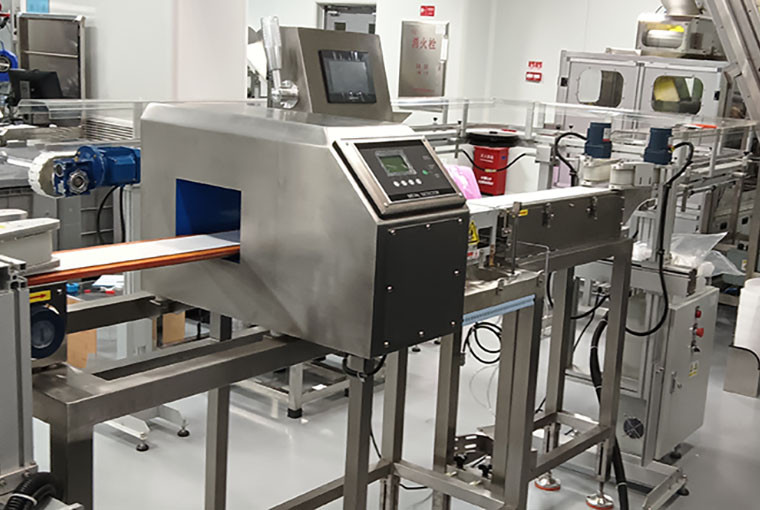
Most sensitivity complaints we hear from food manufacturers have nothing to do with the detector head. The head is fine. The integration is not.
A conveyorized metal detector is a five-stage loop: product transport, detection, signal processing, rejection of non-conforming packs, discharge to the next machine. Weaken one link and you get both failure modes at once — contamination slipping through, and good product filling the reject bin all shift.
Here is how to plan it: where the detector belongs, how much clear space it needs, how packaging changes the answer, and how to prove the loop works at audit.
Step 1: Decide Where the Detector Belongs Before You Buy It
Placement is a HACCP decision before an engineering one. Walk the line and mark where metal can realistically enter: mixers, slicers, size-reduction equipment, sieves, filling heads, any station where operators handle tools. Those hazards define your critical control points. Most plants end up with two inspection points, not one:
● Upstream, in bulk or raw material — catches fragments while the rejected quantity is small and the source is still traceable to one machine.
● End of line, after sealing — the last checkpoint before product leaves your control, and the one retail auditors focus on.
And one rule that gets ignored: never mount the head on an incline, a decline, or immediately after a curve. Product tumbles, spacing collapses, signal becomes noise.
Let Your Packaging Material Decide the Inspection Point
This is where integration projects most often go wrong. Two materials that look almost identical on the shelf behave completely differently inside a detection field.
Metallized film — the shiny layer on most snack and coffee packs — carries a vapour-deposited aluminium coating a fraction of a micron thick: conductive, but weakly and inconsistently. A multi-frequency conveyor metal detector profiles that packaging signal and suppresses it, so you can still inspect after sealing.
Solid aluminium foil — lidding foil, foil laminate sachets, foil-wrapped bars — behaves as a continuous conductor and shields the product from a conventional balanced-coil field. You cannot tune your way out of that; you design around it.
Packaging material vs. recommended inspection point
| Packaging | Behaviour in the field | Where to inspect | SameGram configuration |
Clear film, PE/PP, board, glass, unpackaged product | Effectively transparent | End of line, after sealing | |
| Metallized film (snacks, coffee, powders) | Weak, variable conductive signal | End of line — multi-frequency suppression required | |
| Solid aluminium foil / foil laminate | Shields the product; conventional detection blinded | In bulk before sealing, or a foil-capable detector at end of line | Bulk inspection upstream + DD-220 foil-pack detector |
| Dry powders and granulates in free fall | Gravity flow, no belt available | At the drop pipe, before the filler |
Practical takeaway: specify for the packaging you will run in two years, not the one on the line today. Retrofitting a detection point into a finished line costs far more than allowing for it at layout stage.
Step 2: Size the Metal-Free Zone Before the Conveyor Is Built
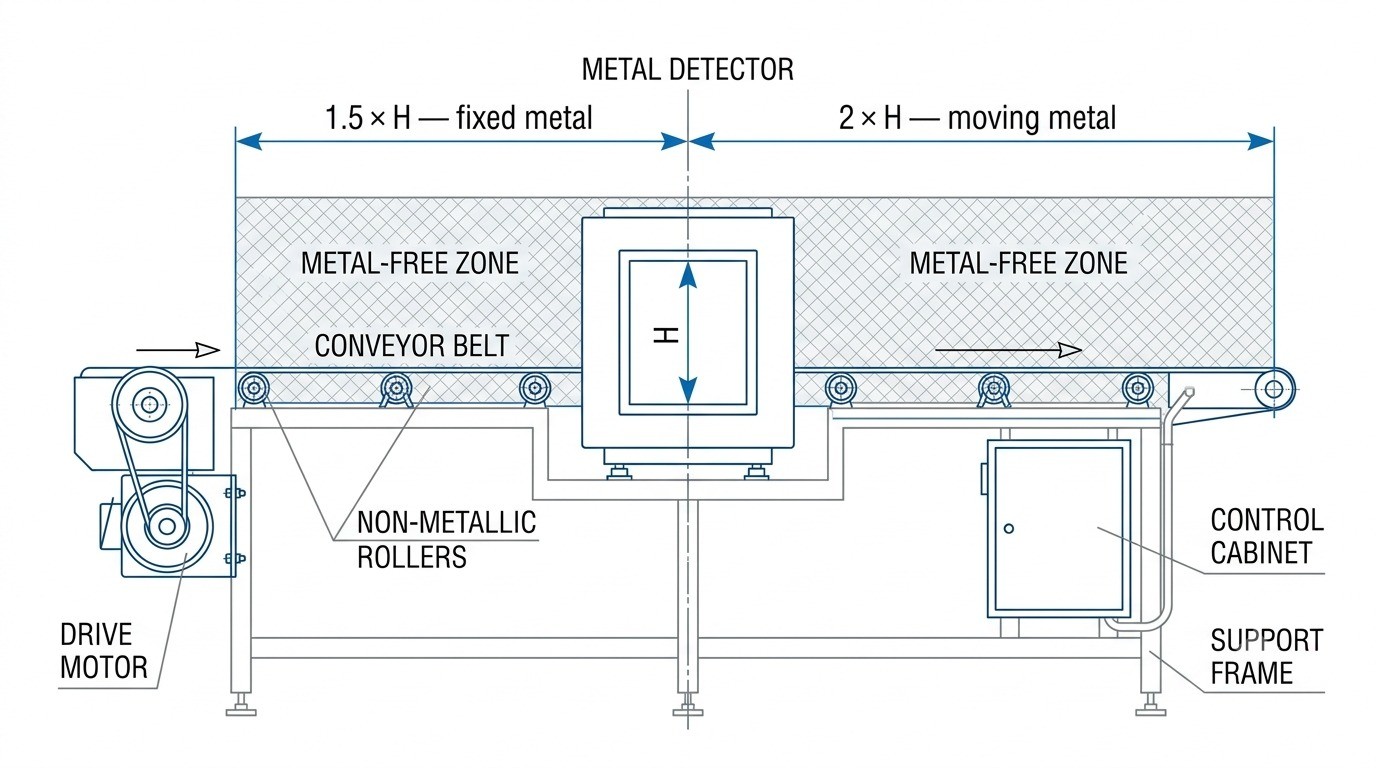
The aperture's field extends well beyond the physical opening. Any metal inside it — a roller, a bearing housing, a bracket, the frame of the next machine — either desensitises the detector or generates phantom signals. The established rule:
● ≈ 1.5 × aperture height of clear space each side for fixed metal structures.
● ≈ 2 × aperture height for moving metal — rollers, drive shafts, reject arms.
That is why an inspection conveyor runs 2–4 metres, not the width of the head. Budget the floor space early. Inside the zone:
● Belt: food-grade PU, PVC or modular plastic — never metal, wire-reinforced, or spliced with metal fasteners.
● Hardware: non-ferrous rollers near the aperture; motors, gearboxes and the cabinet outside the zone.
● Frame: rigid 304 stainless. A flexing frame feeds vibration into the coils, and vibration reads as noise — costing you exactly the stainless-steel sensitivity you paid for.
● Electrical: proper earthing and shielded cabling; keep VFDs and welding circuits well clear.
● Aperture: size it to the product, not the conveyor. Sensitivity falls as aperture area grows, so unused headroom is sensitivity discarded.
Step 3: Synchronise Speed, Spacing and Reject Timing
Detection is a timing problem. The pack must sit in the field long enough to be read, and the rejector must fire when that pack — and only that pack — is in front of it. Three variables must agree:
1. Belt speed. Faster belts shorten dwell time, and small or low-conductivity contaminants are missed first. SameGram conveyor detectors run 25 m/min as standard with adjustable and customised speeds — match line speed to detection capability rather than assuming the detector will keep up.
2. Product spacing. Packs that touch read as one object, so the rejector removes two or three units instead of one. Guides and a metering infeed pay for themselves in yield.
3. Reject delay. Drive it from encoder feedback, not a fixed timer, and add a downstream confirmation sensor so the system knows the pack actually left the belt.
Step 4: Match the Rejector to the Pack, Not to the Budget
A detector without a matched rejector is an expensive alarm. Choose from how the pack physically behaves:
| Product type | Recommended rejector | Why |
Light bags, pillow packs, low-density items | Air jet | Non-contact and very fast |
| Cartons and bagged goods up to 1 kg | Flipper / swing arm | High cycle rate, clean repeatable sweep |
| Heavy boxed or rigid products | Heavy-duty pusher | Force for mass without disturbing neighbouring packs |
| Soft, thick or fragile products | Up-and-out dual flap | Gentle handling, no crushing |
Flat, thin bags and sachets | Belt drop | Pneumatic lift rods handle flat packs air jets cannot move reliably |
Whichever you choose, the reject bin must be lockable and key-controlled, with access restricted to QA. That is a direct BRC and IFS expectation, and one of the first things an auditor physically checks.
Step 5: Connect the Detector to Your Plant Data Backbone
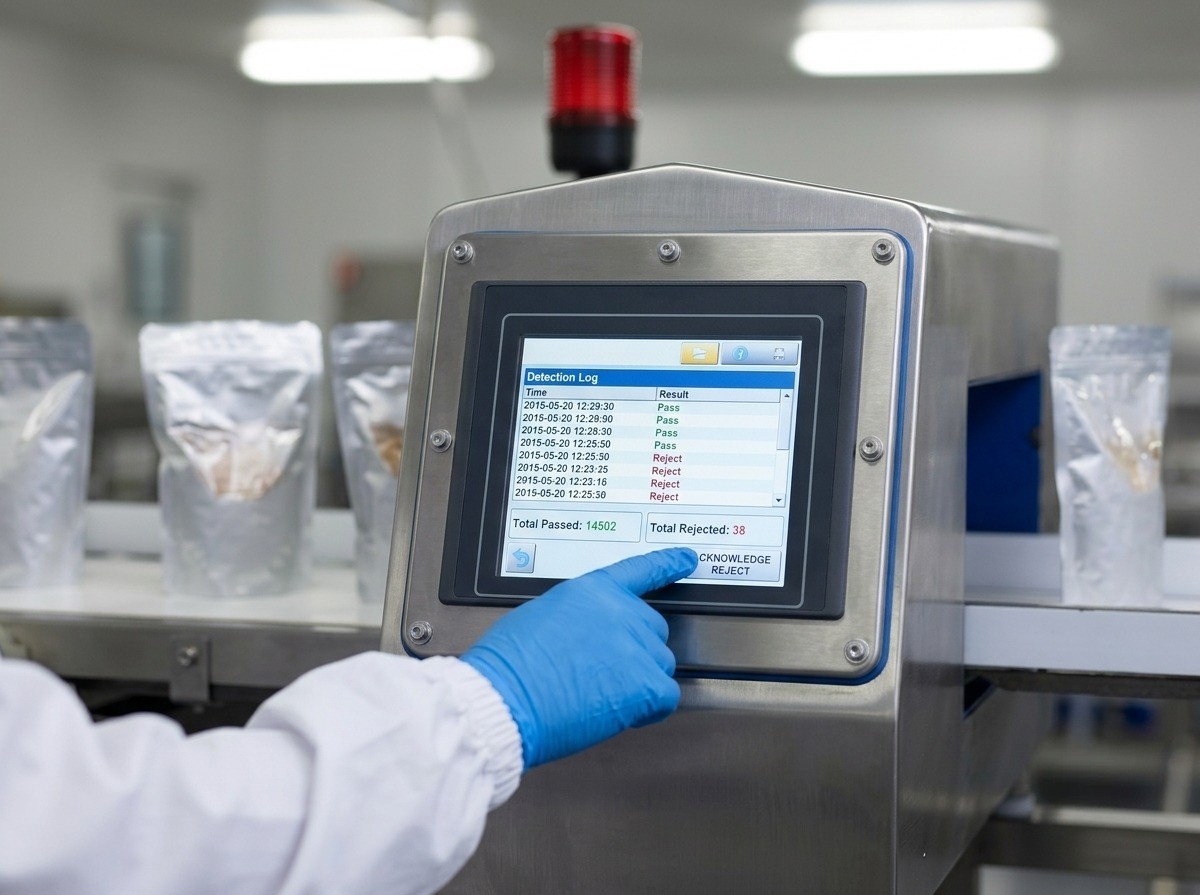
On an automated line, an inspection point that only beeps is a compliance gap. Every SameGram conveyor metal detector ships with standard I/O, RS-232/RS-485 and Ethernet, plus optional OPC and Profinet for direct MES/ERP integration — giving you time-stamped reject events tied to batch and shift, sensitivity locked behind user-level access control, and exportable verification records instead of a clipboard in a drawer.
Where floor space is tight, the Checkweigher Metal Detector Combination System SCM-4530L2 merges both checks into one frame: 1–2000 g weighing at ±0.3–1 g, belt speed 5–28 m/min, 304 stainless, 100 stored recipes, and independent rejectors for weight and metal faults — so an underweight pack and a contaminated pack never land in the same bin.
Step 6: Commission, Validate, Then Keep Validating
Commissioning is not "it powered up." Verify belt speed, confirm reject delay at every speed you will actually run, check spacing under real throughput, and set sensitivity with genuine product on the belt — not an empty conveyor. Then hold the routine:
● Three-sphere testing with certified ferrous, non-ferrous and stainless steel pieces, every two to four hours plus start-up, changeover and end of run. Stainless is hardest to find, so it sets your real detection limit.
● Test through the pack, worst-case position — aperture centre, product centre, where field strength is lowest.
● A written action plan for failures, including quarantine back to the last passed test.
● Declared sensitivity on the machine — for example Fe Φ0.8 mm, Non-Fe Φ1.2 mm, SUS Φ1.5 mm on a DD-390. Published figures beat "high sensitivity" every time.
Your audit inherits your supplier's documentation, so certification matters. SameGram conveyor metal detectors are independently certified:
● EMC + MD + LVD Certification → — Electromagnetic compatibility, Machinery Directive and Low Voltage Directive.
● RoHS Certification → — Restriction of hazardous substances — required by most retail programmes.
Working With SameGram on Your Line Integration
SameGram is a high-tech manufacturer specialising in dynamic checkweighing, metal detection and intelligent inspection systems for food, pharmaceutical, logistics and cosmetics production. Our R&D team brings over 16 years of experience and multiple patents, every machine is built in our 4,000 m² factory, and more than 5,000 production lines worldwide run on SameGram equipment — backed by a 12-month warranty and lifetime technical support.
Because our detectors, rejectors and checkweighers are engineered on one modular platform, integration questions get answered by the people who built all three. Explore the conveyor metal detector range, browse all inspection and weighing solutions, or read more about how we work.
Send Us Your Product. We'll Send You the Sensitivity Report.
Industrial inspection cannot be specified from a datasheet alone. Ship us your actual product in its actual packaging and our applications team will run it on the matching configuration, then return a documented sensitivity report for Fe, Non-Fe and stainless steel — free of charge, before you commit to anything.
Frequently Asked Questions
How much space does a conveyorized metal detector need?
Roughly 1.5 × aperture height of metal-free space each side for fixed structures, about 2 × for moving metal — in practice a 2–4 metre inspection conveyor, not just the width of the head.
Can I inspect products packed in aluminium foil?
Metallized film, yes — after sealing, using multi-frequency suppression. Solid foil needs bulk inspection before sealing, or a foil-capable detector such as the DD-220 series.
Separate detector or a checkweigher combination system?
Tight floor space with a checkweigher already planned favours a combination unit like the SCM-4530L2. If the two checks belong at different points in the process, keep them separate.
SameGram Hot-Sale Metal Detector
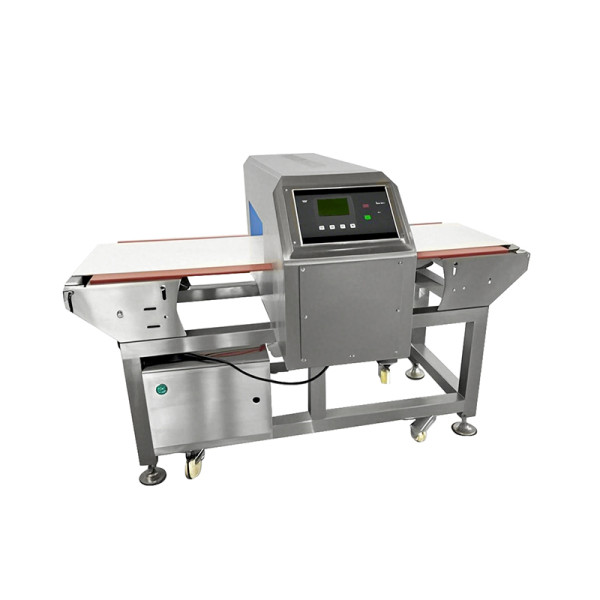
DD-720 is a belt conveyor metal detector with unmatched sensitivity, ideal for food and pharma.
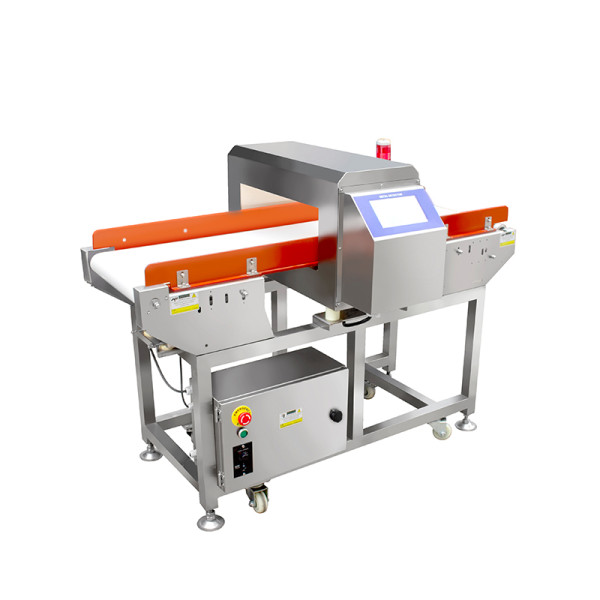
DD-500 Series is an advanced conveyor belt metal detector using smart touch-screen control. Ideal for food production and other
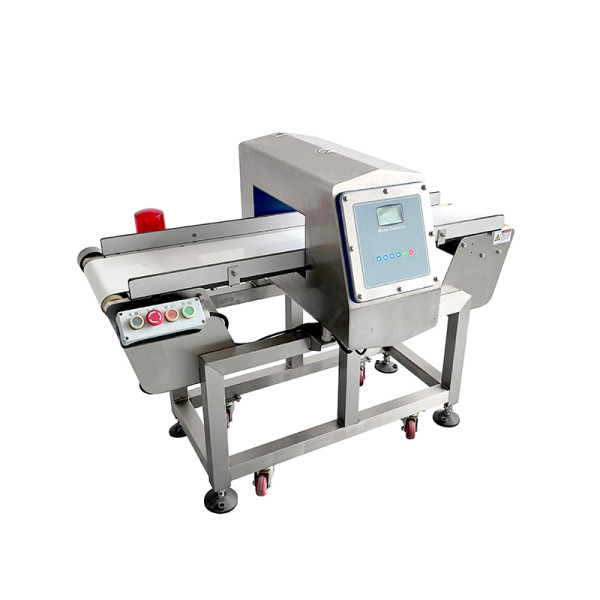
Customizable metal detector for conveyor belt with dual frequency, high sensitivity, and strong anti-interference.
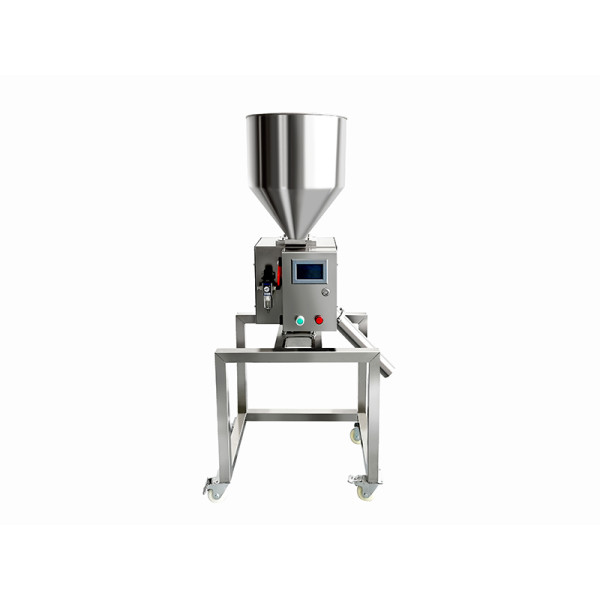
The HC-700 gravity metal separator can perform precise, hygienic, and sealed metal removal from bulk materials (grains etc.)
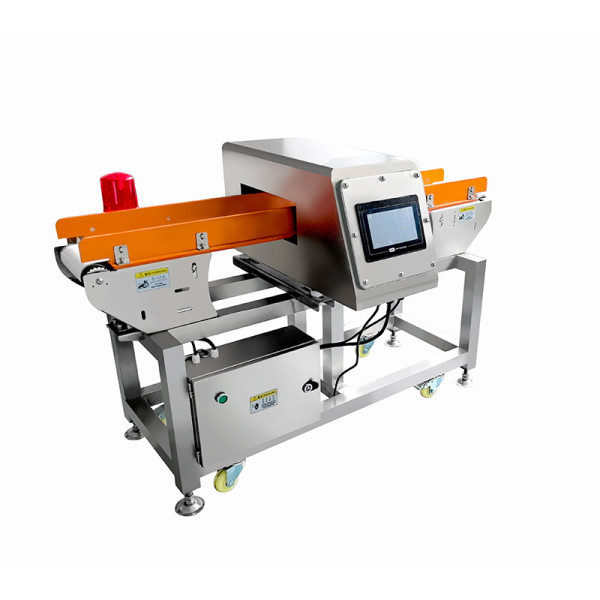
DD-220 is a food conveyor metal detector designed for aluminum foil packaging,with high sensitivity and easy integration.