



Conveyor Metal Detector for Wet Food | SameGram DD-390
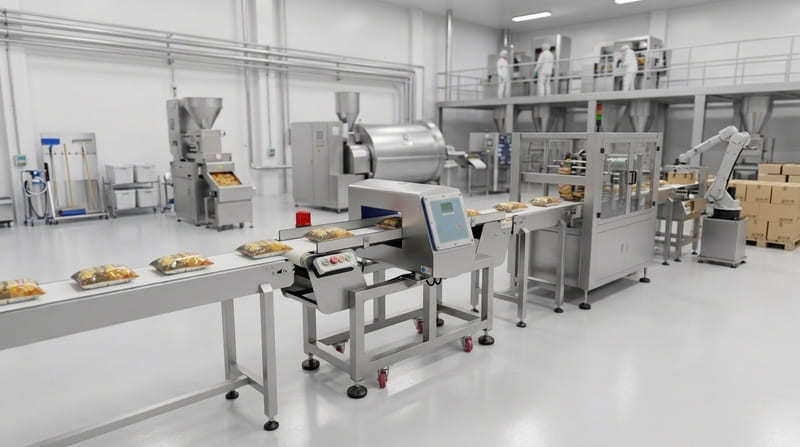
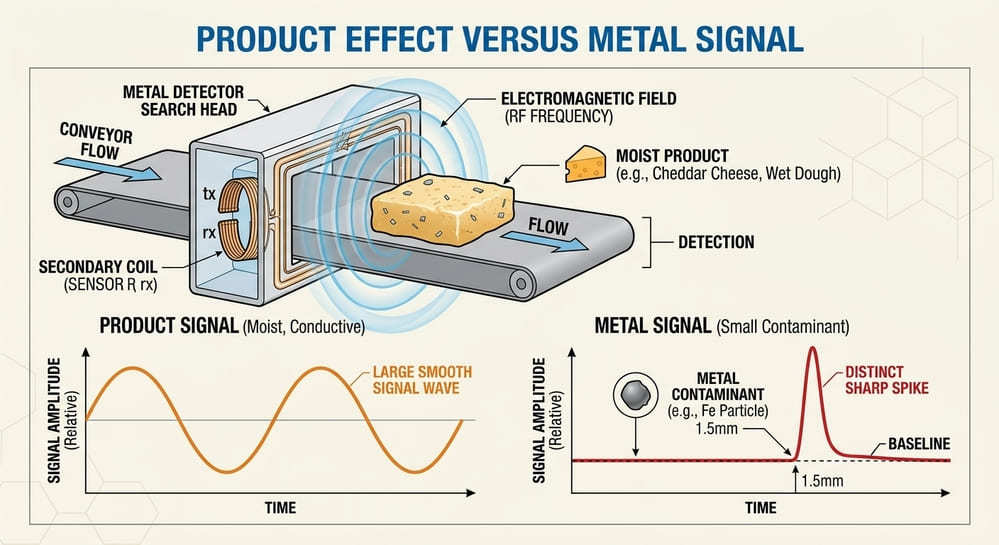
A conveyor metal detector is one of the hardest-working machines on a food line, and not because the electronics are exotic. The difficulty is that food itself pushes back. The instant a damp, salted, or chilled pack crosses the search head, it generates its own electromagnetic signal — what the industry calls the "product effect" — that can look almost identical to a real contaminant.
At SameGram, we have spent years building inspection equipment for exactly these conditions. Our DD-390 grew out of a brief from food plants: catch ferrous, non-ferrous, and stainless-steel contamination in high-moisture, high-salt, and high-fat products, without wasting good output.
This article explains how the DD-390 deals with the problems plant managers hit every shift, and how to commission it for your product rather than a laboratory.
Why metal detection is a control point, not a checkbox
In any HACCP plan, a metal detector sits at a Critical Control Point — the last dependable barrier before product ships. It protects downstream equipment from rogue metal and your brand when one contaminated pack could mean a recall. For plants running multiple categories, the same unit often has to cover very different products in a single day. See how we apply this across sectors in our industry applications overview.
The harder your product is to inspect, the more your detector's design matters — and wet, salty food is about as difficult as it gets.
The real enemy: product effect on wet and salty lines
Every product produces a signal as it passes through the detection field. Dry goods such as biscuits, chocolate, or powders barely register. Moist products — bread, fresh meat, dairy, prepared meals — produce a large signal; salt with free water is the worst because it creates a resistive effect the detector must see through.
Temperature makes it worse. A partially thawed pack releases free water that raises the product effect and quietly lowers usable sensitivity — which is why a detector that passed validation can start false-alarming after a formulation tweak or a warmer shift.
Understanding this is the first step. The second is having a detector that compensates for it instead of simply turning up the gain.
How the DD-390 compensates: dual-frequency detection and self-learning
The DD-390 runs dual-frequency detection tuned to the product in front of it. During setup it performs a full product calibration: it learns the uncontaminated product's signal, measures both resistive and reactive components, and sets a phase angle that separates product from metal. The measured ratio stays constant for clean product and breaks the moment metal is present — that is the trigger.
What makes this practical is the self-learning and memory function. Once a product is taught, its parameters are stored. The DD-390 holds more than 200 recipes, so a line that switches between frozen fish, bread, and sauce packs can recall each one without re-tuning. Auto calibration is straightforward: run at normal speed, keep at least one head width of spacing between packs, and pass 30 to 50 clean units through the head. Our metal detection solutions page covers the full model range.
That capability — learn once, recall instantly — is what keeps a wet-food line running instead of stalling at every changeover.
Catching stainless steel in moist products: the IXR function
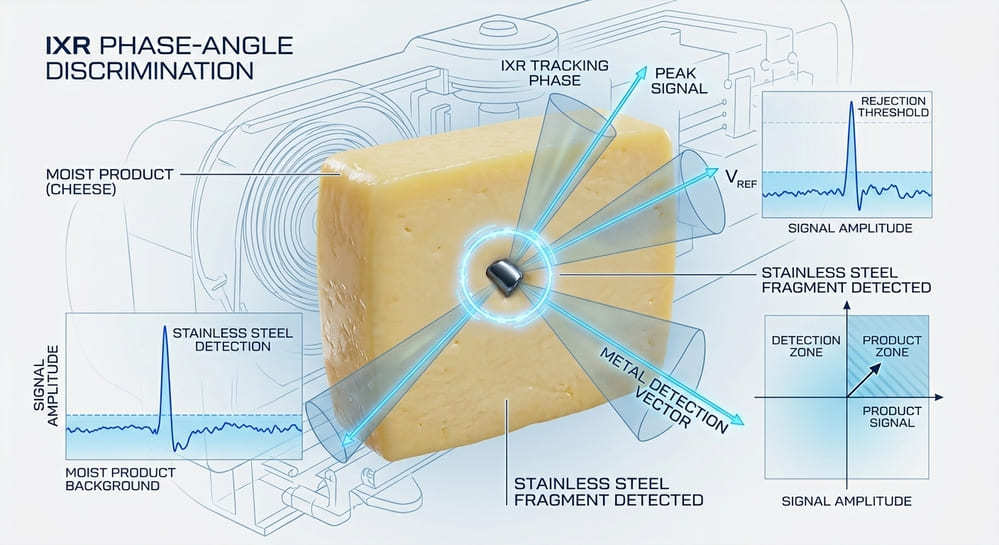
Stainless steel, especially non-magnetic SUS304 and SUS316, is the hardest metal to see — typically needing a sphere 1.5 to 2 times larger than ferrous. On moist products, the gap widens, which is where the DD-390's IXR (Intelligent Tracking) function earns its place.
IXR continuously tracks the phase angle of contaminants across moist and dry packs, sharpening detection of stainless fragments a conventional setting would miss. It needs a photoelectric sensor at the infeed and is built for conveyor use — the difference between "we hope it catches it" and "it catches it."
Cutting false rejects during changeover
False rejects are the silent tax on a food line — lost margin and a sign your settings are drifting. The DD-390 attacks this two ways.
First, the 200-recipe library means changeover is a menu selection, not a re-engineering job. Second, reject timing is tunable so the machine removes only the contaminated unit. Package spacing is set as a percentage of pack length — usually 100 percent — and if you are unsure which unit is contaminated, you can fine-tune whether it rejects one pack or two. After any timing change, verify by taping a test piece to a product, running it through, and confirming the reject fires to remove only that pack. On combined lines, our combination inspection systems fold weighing and metal checking into one logic.
The honest takeaway: no detector eliminates every false reject, but a unit that learns your product and stores the result stops most of them at the source.
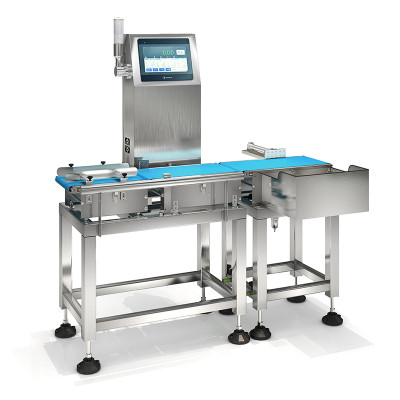
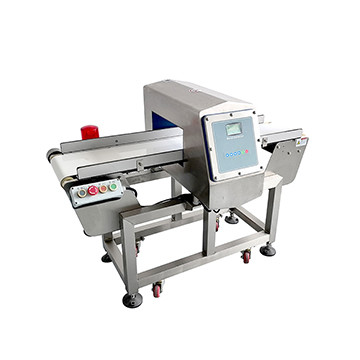
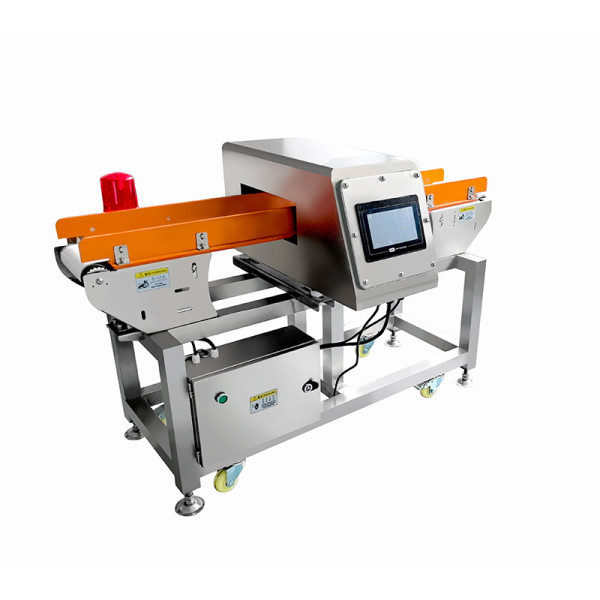
Sensitivity (empty belt surface): FE(Φ0.8mm),NON-FE(Φ1.2mm),SUS316(1.5Φmm)
Production speed: 1~1000m/min,fixed speed 25/min
Effective detection channel(mm): 400 ×120 (W×H) customizable
Conveyor belt material: Food grade PU belt
Structure: SUS304,Comply with HACCP, GMP, FDA, CAS and other
Protection: IP 66 (probe) Others are IP54, optional
HACCP traceability you can actually defend in an audit
The DD-390 stores up to 1,500 event logs with a running reject total, per-product reject history, and production counters. Combined with the daily verification test, you get a traceability trail that satisfies an auditor without a separate spreadsheet. Our quality and compliance resources explain how to document this for retailer audits.
For HACCP validation: commission each new product with full calibration, test certified pieces at the leading edge, center, and trailing edge (and on top, inside, and underneath), repeat at least three times per metal type, and record date, time, product, piece size, and pass or fail. If a piece fails after adjustment, the guidance is explicit — do not run production, and contact technical support.
Dropping into an automated line
Integration is where many detectors fail quietly. The DD-390 ships with six configurable relay outputs — Reject 1, Reject 2, Fault, Alarm, Warning, and QA Light — and a photoelectric input that synchronizes inspection with rejection. That lets it drive a pneumatic pusher, air blast, or flap gate and signal your line controller or stack light without custom electronics. Modular construction means the belt, reject device, and search head are serviceable without a full teardown.
If your line already runs our checkweighers or combination systems, the metal detector slots into the same control logic, keeping training and maintenance simple.
Specifications that matter on the floor
● Detection sensitivity (empty belt): Fe 0.8 mm / Non-Fe 1.2 mm / SUS316 1.5 mm
● Construction: stainless steel SUS304, food-grade removable PU belt
● Ingress protection: IP66 on the probe
● Recipes and logs: 200+ product recipes, 1,500-event log
● Speed: 1 to 1000 m/min, adjustable
● Outputs: 6 relay outputs; multi-language HMI (EN, ES, FR, DE, IT, and more)
These figures are the practical, product-detection values relevant to production — not laboratory maxima — and they should be confirmed against your own product during commissioning.
Built and certified for food plants
The DD-390 carries CE certification covering EMC, the Machinery Directive (MD), and the Low Voltage Directive (LVD), plus RoHS compliance. It is also covered by UDEM International certification and ICR conformity verification. You can review the full documentation on our certificate overview page, or open each directly: CE (EMC+MD+LVD), RoHS, UDEM International, and ICR conformity verified.

Frequently asked questions
Can a metal detector find glass, stone, or bone? No — the DD-390 detects metal only. For non-metallic objects, pair it with an X-ray system from our broader inspection range.
Why does frozen food temperature change sensitivity? Partially thawed product releases free water, raising the product effect. Keep stock at a stable temperature and re-run auto calibration if conditions shift.
Do I need to recalibrate every product? Only when you first introduce it, or after a significant formulation, temperature, or line change — after that it is a one-tap recipe recall.
About SameGram

SameGram Equipment Co., Ltd. designs and manufactures inspection and weighing equipment for food and industrial lines, from conveyor metal detectors to checkweighers and combination systems. Everything we build is engineered for the messy reality of a running plant, not a showroom. If you fight false rejects on a wet or salty line, our team will run a detection trial with your actual product — the only way to know it performs is to test it on what you make. Visit SameGram or contact us.
Author: Tony, Founder & CTO, SameGram.
"At SameGram, every innovation starts with listening — to machines, to data, and most importantly, to our customers."
Hot-Sale Metal Detector
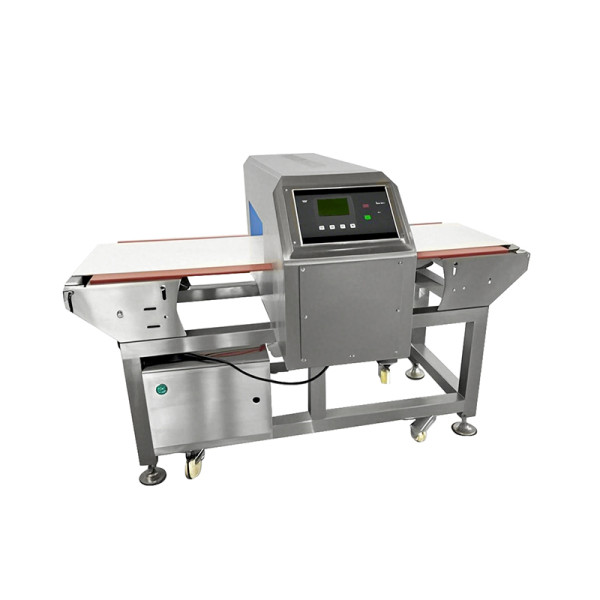
DD-720 is a belt conveyor metal detector with unmatched sensitivity, ideal for food and pharma.
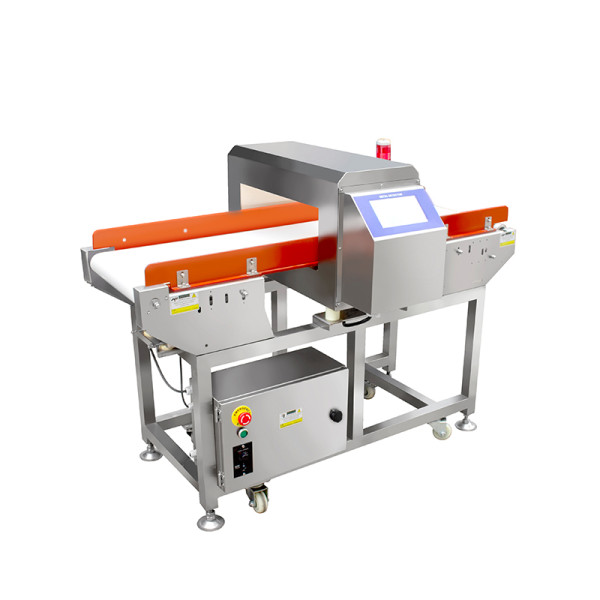
DD-500 Series is an advanced conveyor belt metal detector using smart touch-screen control. Ideal for food production and other
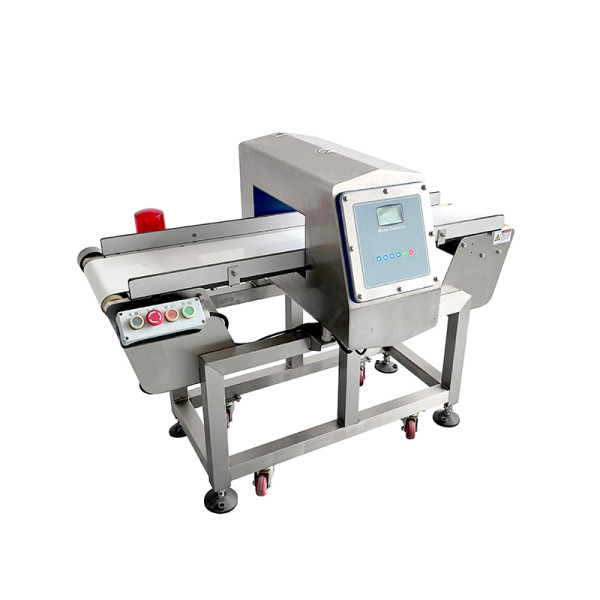
Customizable metal detector for conveyor belt with dual frequency, high sensitivity, and strong anti-interference.
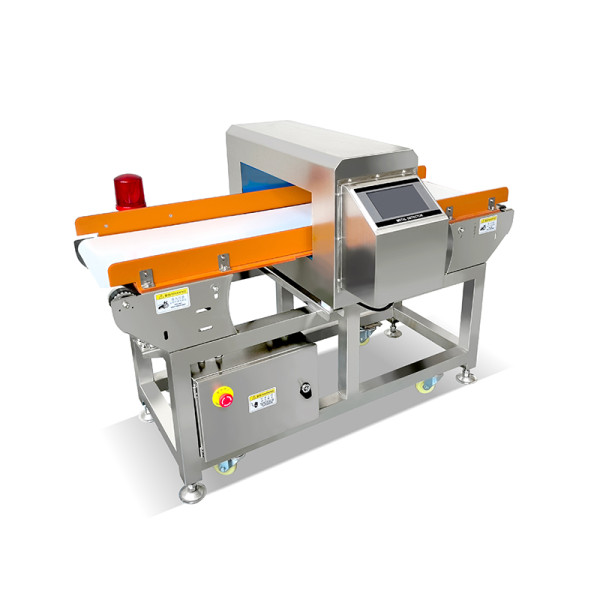
DD-360 Series is a food-grade metal detector conveyor system. Ideal for food industry and food production lines.
DD-220 is a food conveyor metal detector designed for aluminum foil packaging,with high sensitivity and easy integration.