




Audit-Ready Conveyor Metal Detectors for FSMA & BRCGS Compliance
In modern food and pharmaceutical automated production lines, a conveyor metal detector serves a dual purpose. It is no longer just a physical screening device designed to catch stray stainless steel or ferrous fragments; it is a Critical Control Point (CCP) operating at the heart of your Hazard Analysis and Critical Control Point (HACCP) framework.

For Quality Assurance (QA) and Quality Control (QC) managers, the landscape of compliance has fundamentally shifted. When a third-party auditor walks onto the factory floor, their primary concern often extends beyond asking, "Can this machine detect metal?" Instead, the scrutiny focuses heavily on data: "Is the testing and detection process fully traceable, and is the data tamper-proof?"
Transitioning from traditional manual logs to an audit-ready metal detector is no longer an optional upgrade—it is a compliance necessity. This article breaks down the latest international regulatory requirements, dissects the vulnerabilities of manual record-keeping, and explores how automated data logging systems can permanently eliminate audit friction while protecting your bottom line.
1. The Shifting Regulatory Landscape: Why Paper Logs Fail Audits
The days of relying on operators to manually check off boxes on a clipboard every hour are drawing to a close. Global food safety standards and regulatory bodies are aggressively closing the loopholes associated with human error.
1.1 FSMA Section 204 & The 24-Hour Rule
The U.S. Food and Drug Administration’s (FDA) Food Safety Modernization Act (FSMA) Section 204 represents a paradigm shift in traceability. For covered entities, the law mandates the precise capture of Key Data Elements (KDEs) during Critical Tracking Events (CTEs).
Crucially, FSMA 204 establishes the "24-Hour Rule." If the FDA initiates a regulatory inquiry or a recall investigation, the facility must provide an accurate, sortable electronic traceability spreadsheet within 24 hours. A paper-based system—where quality teams must frantically dig through filing cabinets to cross-reference production batches with metal detector reject logs—simply cannot meet this strict deadline without massive disruption to operations.
1.2 BRCGS Issue 9 & GFSI Requirements
For facilities operating under the Global Food Safety Initiative (GFSI) benchmarks, compliance with standards like BRCGS Issue 9 is non-negotiable. Issue 9 places intense focus on the validation of CCPs.
According to the latest BRCGS audit checklists, auditors require concrete proof that metal detectors are being routinely challenged with certified test pieces. If a test piece is run, but the event is not accurately documented with a time stamp, or if a parameter change occurs without a recorded authorization, the facility is highly likely to incur a Major Non-conformity. An audit-ready metal detector inherently prevents this by automatically logging every system interaction.
1.3 The Flaws of Manual Record-Keeping
● Illegibility: Handwritten notes can be difficult to read, leading to data misinterpretation during an audit.
● Missing Entries: During high-speed production or shift changes, operators may simply forget to log a routine sensitivity check.
● Lack of Audit Trails: Paper forms cannot verify who actually made an entry or if a parameter was altered without authorization after the fact.
2. Core Pillars of an "Audit-Ready" Metal Detection System
To truly future-proof a production line, a conveyor metal detector must be engineered from the ground up to handle secure data acquisition. But what exactly makes a system "audit-ready"?
2.1 Principles of Data Integrity (ALCOA+)
High-end pharmaceutical and food manufacturing environments adhere to the ALCOA+ data integrity principles. This means that every piece of data must be Attributable, Legible, Contemporaneous (recorded at the time it occurs), Original, and Accurate. An automated metal detector event logging system naturally satisfies these criteria by removing human translation from the data capture process.
2.2 Automated Time-Stamped Event Logs
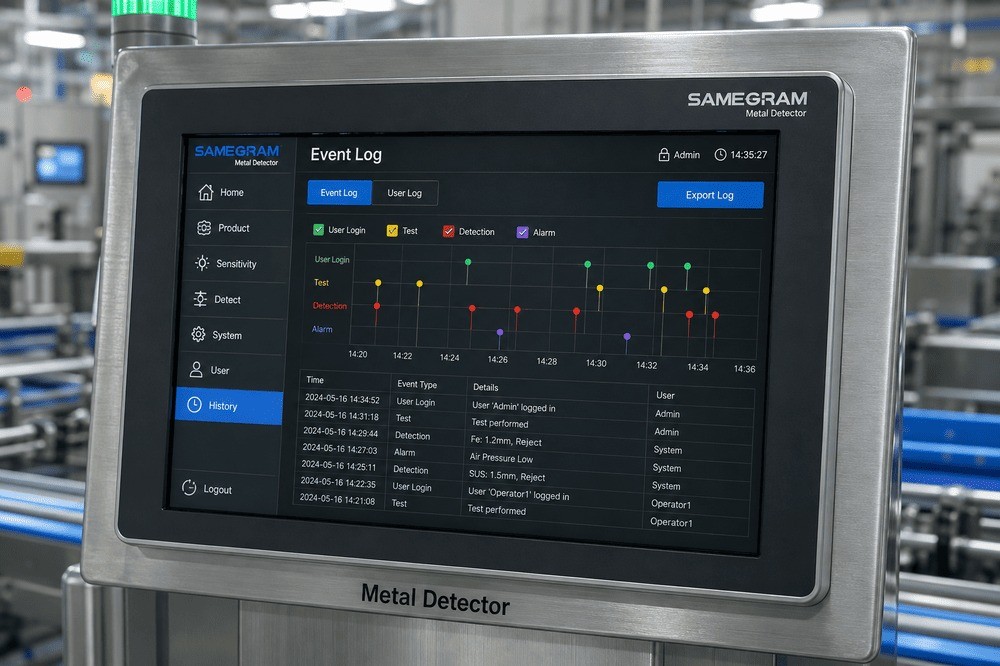
An audit-ready machine meticulously records every micro-event in the background. Whether it is a successful product pass, an automatic rejection due to foreign body detection, a routine test piece challenge, or a system fault, the event is immediately saved to the internal drive. These logs are time-stamped down to the exact second and cross-referenced with the active product batch code, ensuring a seamless chronological history.
2.3 Multi-Level Password & User Access Control
A critical vulnerability in metal detection is unauthorized parameter adjustment. If an operator slightly lowers the machine's sensitivity to prevent false alarms caused by product effect (such as moisture or salt content), the entire batch becomes non-compliant.
Audit-ready systems solve this through multi-level password protection. For example, a basic Operator profile only has access to start/stop functions. A QA profile can initiate calibration routines, while only a Senior Admin can modify phase angles or sensitivity thresholds. Every login and parameter change is permanently stamped in the audit trail with the corresponding user ID.
2.4 Encrypted Data Export & Connectivity
Data is only valuable if it is accessible and secure. Modern systems allow QA managers to effortlessly export encrypted, read-only reports via USB drives. Furthermore, advanced machines can directly integrate with factory MES/ERP networks via Ethernet/IP or OPC UA protocols, ensuring real-time, tamper-proof data transmission to central servers.
3. Business ROI: How Data Automation Protects Your Bottom Line
Investing in a digital, audit-ready framework is not merely a regulatory tax; it yields tangible returns on investment (ROI) that directly impact operational profitability.
3.1 Zero Audit Friction
Unannounced audits are highly stressful and resource-intensive. With an automated data logging system, the stress is entirely neutralized. When an auditor requests the CCP history for a specific batch produced three months ago, the QA manager simply queries the system and exports a clean, formatted PDF or Excel report in minutes. This level of organization immediately establishes a strong sense of trust with regulatory inspectors.
3.2 Eliminating Human Error & Fines
Manual record-keeping requires labor. By automating the data capture at your CCPs, you free up your quality control team to focus on actual quality improvements rather than endless paperwork. More importantly, eliminating missing logs means avoiding the severe financial penalties, downgraded audit scores, or devastating retailer delistings that stem from compliance failures.
3.3 Rapid Root-Cause Analysis
When a spike in rejection rates occurs, time is money. Granular data logs allow engineers to conduct immediate root-cause analysis. By reviewing the exact time, frequency, and phase data of the rejections, teams can quickly determine if they are dealing with a raw material contamination issue, a mechanical vibration interference, or a severe product effect shift, significantly reducing costly line downtime.
4. SameGram Conveyor Metal Detectors: Built for Seamless Compliance
4.1 Integrated Audit-Ready Architecture
Every SameGram conveyor metal detector comes equipped with an advanced Intelligent Detection Solution. Our intuitive HMI systems automatically handle BRCGS Issue 9 CCP records and FSMA 204 requirements. With built-in multi-level user authentication, massive onboard storage for millions of event logs, and secure one-touch data export, our machines act as an automated extension of your QA department.
4.2 Customizable Integration & Remote Support
No two production lines are identical. We provide Customization / Customized Weighing and Inspection Solutions to ensure our detection systems integrate perfectly with your existing architecture. Whether you need to synchronize data with upstream equipment or integrate the metal detector with a combination weigher and labeling machine for a fully automated end-of-line solution, our engineering team makes it happen. Furthermore, our Remote Support capabilities allow for secure, rapid remote diagnostics, ensuring maximum uptime.
For more details on integrating these systems into specific processing environments, explore our Food Industry Solutions and Pharmaceuticals and Health Products application pages.
4.3 IP69K Washdown Durability & Global Certifications
Data integrity is useless if the hardware fails in a harsh environment. SameGram metal detectors feature food-grade stainless steel construction and are available with IP69K washdown ratings, allowing them to withstand the high-pressure, high-temperature sanitization processes mandated in modern food and pharmaceutical plants.
Our commitment to safety and global standards is fully verified. We invite you to review our official compliance credentials, demonstrating our equipment's readiness for global deployment:
5. Conclusion & Actionable Next Steps
Maintaining paper logs for critical control points is a massive liability masquerading as a cost-saving measure. As global regulations tighten, an audit-ready conveyor metal detector with automated event logging is the ultimate insurance policy. It protects your brand reputation, prevents devastating recalls, and serves as your ticket to remaining an approved supplier for major global retailers.
Don't wait for your next unannounced audit to discover the vulnerabilities in your traceability system. Upgrade to an automated, intelligent detection framework today.
Ready to modernize your CCP compliance? Contact the SameGram Pre-Sales Consulting team today for a tailored application analysis, or visit our Product Center to learn how our digital inspection solutions can secure your production line.
Author: Tony, Founder & CTO, SameGram.
"At SameGram, every innovation starts with listening — to machines, to data, and most importantly, to our customers."
Hot-Sale Metal Detector
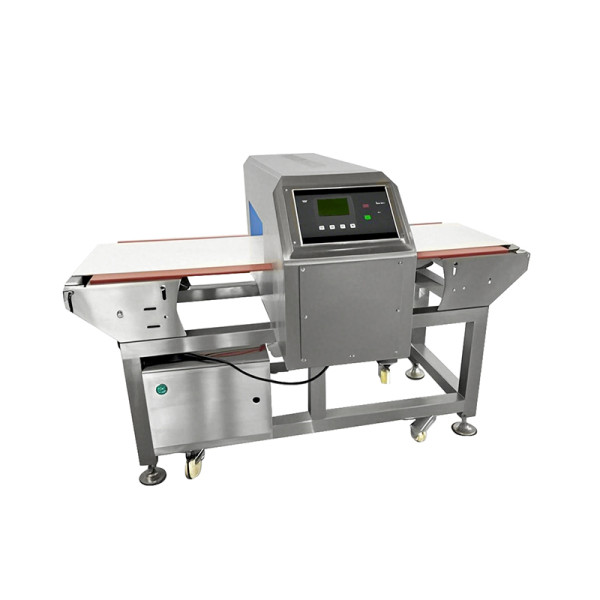
DD-720 is a belt conveyor metal detector with unmatched sensitivity, ideal for food and pharma.
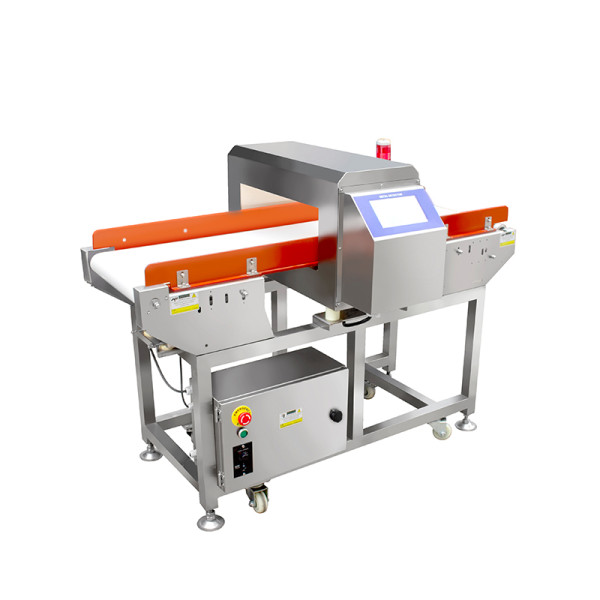
DD-500 Series is an advanced conveyor belt metal detector using smart touch-screen control. Ideal for food production and other
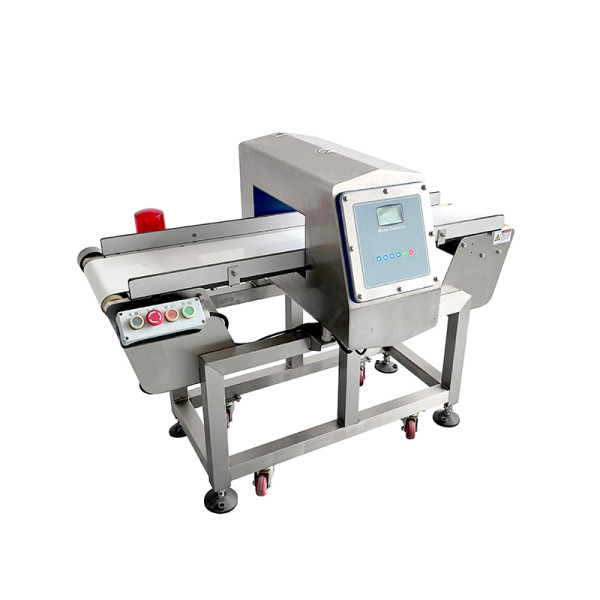
Customizable metal detector for conveyor belt with dual frequency, high sensitivity, and strong anti-interference.
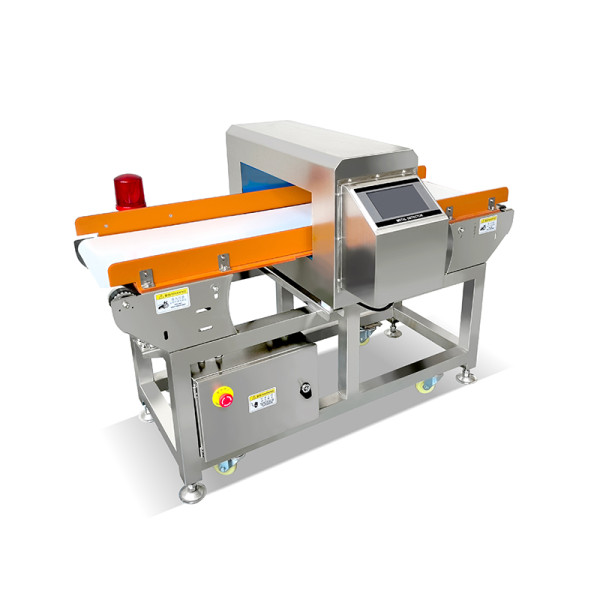
DD-360 Series is a food-grade metal detector conveyor system. Ideal for food industry and food production lines.
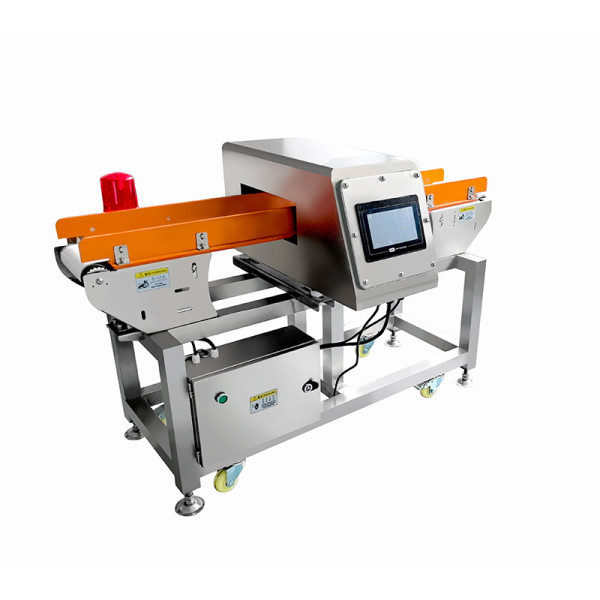
DD-220 is a food conveyor metal detector designed for aluminum foil packaging,with high sensitivity and easy integration.