




Net Content Tolerance by Country: 7-Market Table 2026
Net Content Tolerance by Country in 7 Export Markets
A single 500 g pack of green tea rolls off one production line and ships three ways: to a German supermarket, an Indian distributor, and a Tokyo importer. In Germany it clears inspection without a query, because the European table allows 15 g. In Mumbai the consignment is detained, because India counts the line's over-fill tail as a violation exactly as it counts under-fill. In Tokyo the importer is short: Japan's Table 1 allows 10 g on a 500 g pack, not 15 g, and Japan will not let a good batch average cover a light pack. Same recipe, same line, three legal outcomes.
Net content tolerance by country is what separates those three outcomes, and it is the difference between a shipment that clears customs and one that is destroyed at the border. Most exporters learn it the expensive way, because no single page compares the seven major markets side by side. This is that page.
You already know every market has packaging laws. What catches exporters out is how close the numbers are, and how far apart the rules behind them are.
This page puts seven jurisdictions in one frame: the European Union, United States, China, Japan, India, Australia/New Zealand and Canada. For each one you get the tolerance table as the regulator publishes it, the test that regulator actually applies to a batch, and the arithmetic that turns a tolerance into a checkweigher scale division.
Sections 1 and 2 give you the three legal families and the master matrix. Sections 3 to 9 take the markets one at a time. Section 10 is the one worth arguing about.

Key Takeaways - Net content tolerance by country is not one global rule. It is one shared table read through seven different laws. - Seven markets, three legal families: average-quantity (EU, AU/NZ, China, Canada), individual-limit (US, India), minimum-quantity (Japan). - Five of those seven, namely EU, China, India, Australia/NZ and Canada, publish a near-identical tolerance table descended from OIML R87. So do the UK and Singapore. - The numbers match. The legal effect does not. - EU: the table is a soft line. Up to 2.5% of a batch may breach it; none may breach twice it. - India: the same numbers are a per-item hard limit in both directions. Over-fill is a violation. No 2.5% slack, no 2x concept. - Canada allows one pack below the 2x floor. The EU allows none. - Sizing the instrument: EU e ≤ T ÷ 5; US d ≤ MAV ÷ 6 (NIST HB 133, 2026 Ed.); Mexico uncertainty ≤ 0.1 T. - Approvals: MID Annex VIII (MI-006) in the EU, NTEP in the US, JJG 539 / JJG 648 in China, Measurement Canada notices. MI-005 is fuel dispensers, not weighers.
1. The Three Legal Families Behind Net Content Tolerance by Country
Before any numbers, you need the one idea that explains every cross-border surprise: the world's prepackaged-goods laws belong to three legal families. The tolerance numbers often match. The test a regulator applies to your batch does not.
1.1 The average-quantity system (EU, AU/NZ, China, Canada)
Under an average system, the law does not require every single pack to be full. It requires two things instead:
- The mean net content of a sampled batch must be at least the nominal quantity (no tolerance on the average).
- A limited number of packs may fall short of the nominal quantity by up to the tolerable negative error (TNE), and none may fall short by more than twice that error.
This is the model set out in OIML R 87:2016 (Quantity of product in prepackages), codified in the EU as Directive 76/211/EEC (now 2007/45/EC) and copied, with local wording, across China, Australia/New Zealand, and Canada. The relief it gives exporters is real: a few underweight packs are tolerable as long as the batch average holds and no pack is catastrophically short.
1.2 The individual-limit system (US, India)
An individual-limit system rejects the idea of averaging away a short pack. Every package is judged on its own.
- In the United States, NIST Handbook 133 sets a Maximum Allowable Variation (MAV) per package and a two-rule test: the lot average must meet the declaration, and only a strictly limited number of individual packages may fall below declared weight minus the MAV. The US has no European-style "2.5% may be short" allowance. Its slack lives inside the sampling plan instead.
- In India, the Legal Metrology (Packaged Commodities) Rules 2011 apply the same idea to every single package, and, uniquely, in both directions. Over-fill counts against you. Section 7 shows why that one word ("excess") reroutes an entire production line.
1.3 The minimum-quantity system (Japan)
Japan's Measurement Law (計量法) uses a minimum-quantity approach for specified prepackaged commodities: each package must meet the declared quantity within the 量目公差 (ryōmoku kōsa, "quantity tolerance"), and you may not use a batch average to excuse a short pack. Japan also splits its table by commodity class. Almost no other market copies this. The tolerance on a 500 g pack of tea is not the same as on a 500 g pack of fish. We cover this in Section 6.
Mini-story 1 — the 250 g jar that passed in Rotterdam and was detained in Mumbai. A mid-size European spice blending house, call it Mark's Spices, shipped a 250 g jar across the EU under the ℮-mark for years without a single query. The TNE for 250 g is 9 g, so the soft line sits at 241 g and the hard floor at 232 g. Mark's line ran a mean of 252 g. About 2% of packs landed between 238 g and 240 g: below the 241 g line, well clear of the floor, and inside the 2.5% allowance. Every EU inspection passed, and every one of them was right to. Then the same line filled an order for an Indian distributor. India's MPE for 250 g is also 9 g, the identical number, but it applies to each jar, and in both directions. The legal window is 241 g to 259 g, with nothing to absorb an outlier. Mark's upper tail ran to 262 g. Three grams of generosity, repeated across a pallet, put the consignment in detention until it was re-weighed and relabelled. The line had never been compliant for India. It had only ever been compliant for Europe.
1.4 Average-quantity versus minimum-quantity, side by side
| Question | Average-quantity system (EU, China, AU/NZ, Canada) | Minimum-quantity system (Japan) |
|---|---|---|
| What is measured? | The batch, as a statistical population | Each individual package |
| Can a good average rescue a light pack? | Yes, within limits | No, never |
| Packs allowed below the tolerance line | Up to 2.5% of the batch | Zero |
| Packs allowed below twice the tolerance | Zero (Canada: one) | Not applicable, no second band exists |
| Is there a second, harder line? | Yes, the 2x T2 floor | No, one line only |
| Governing text | 76/211/EEC, JJF 1070-2023, NTM Regs 2009, CPLA | Measurement Law (Act No. 51, 1992) |
| Practical consequence for the line | Set the mean above Qn, control the tail | Set every pack above the tolerance, no exceptions |
2. Net Content Tolerance by Country: the Master Comparison Table
| Jurisdiction | Legal family | Governing text (version) | Average ≥ Qn required? | T1 short allowed? | 2x (T2) hard floor | Over-fill regulated? | Lead regulator |
|---|---|---|---|---|---|---|---|
| European Union | Average | Dir. 76/211/EEC → 2007/45/EC | Yes | ≤ 2.5% of batch | 0 allowed | Only if ℮ used | Member-State metrology authorities |
| United States | Individual limit | NIST HB 133 (2026 Ed.) + HB 44 | Yes (no allowance) | Via sampling plan | 0 beyond MAV | No | NIST / state weights & measures; FDA, USDA |
| China | Average | JJF 1070-2023 + SAMR Order No. 70 | Yes | ≤ 2.5% of batch | 0 allowed | No | SAMR |
| Japan | Minimum (per-item) | Measurement Law (Act No. 51, 1992) | No averaging | 0 allowed | 0 allowed | No | METI |
| India | Individual limit | LMPC Rules 2011 (First Schedule) | Per-item only | 0 allowed | MPE itself is the hard limit | Yes (excess or deficiency) | Legal Metrology / state authorities |
| Australia & NZ | Average | NMI Average Quantity System, NTM Regs 2009 reg 4.36 | Yes | ≤ 2.5% of batch | 0 allowed | No | NMI (AU) / Commerce Commission (NZ) |
| Canada | Average | CPLA s.7(3) + Regs s.38/39, Sched. I | Yes (weighted lot avg) | ≤ 2.5% of lot | Max 1 T2 defective | No | Competition Bureau + Measurement Canada |
This is the table to screenshot. It gives the legal family, the governing text, whether averaging is allowed, whether a 2x hard floor exists, and who enforces it. Every tolerance number behind it is in Section 3 onward.
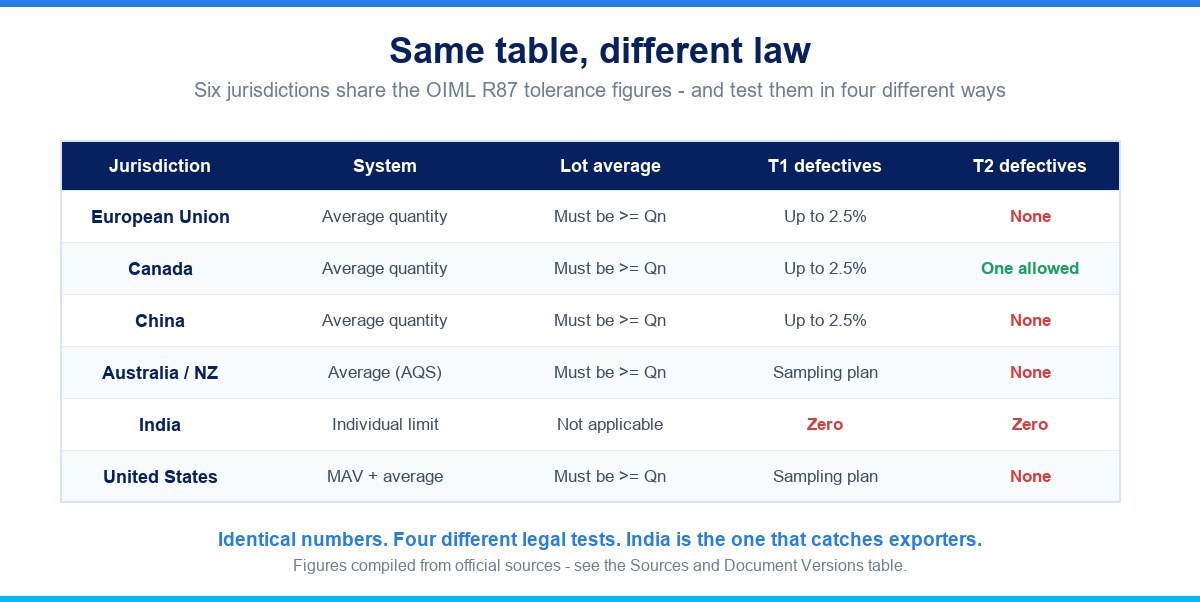
Two markets share the EU table but sit outside the seven above. The United Kingdom runs a post-Brexit average system under the Weights and Measures (Packaged Goods) Regulations 2006, with the same three packer's rules. Singapore applies the Weights and Measures (Defences under s.19) Regulations 2022, First Schedule, an identical nine-band ladder running to over 15,000 g at 1%. Neither changes the core argument; both confirm it.
3. European Union — Directive 2007/45/EC and the ℮-mark
The EU average system is the template the rest of the world copied. Its tolerance ladder comes from OIML R87 and sits in Annex I of Directive 76/211/EEC, carried forward by Directive 2007/45/EC (the EU ℮-mark law).
3.1 The three packer's rules (WELMEC Guide 6.4)
A batch is compliant only if all three hold:
- The actual contents of the packages in the batch, taken as an average, must not be less than the nominal quantity.
- The proportion of packages with a negative error greater than the tolerable negative error (TNE) must not exceed 2.5% of the batch (1 in 40).
- No package may have a negative error greater than twice the TNE (the T2 line).
These are the three packer's rules every EU compliance file quotes. Note the structure: TNE is a soft line, which you may breach up to 2.5% of the time. Twice TNE is a hard floor, which you may never breach.
3.2 The TNE table and the T1 / T2 bands
| Nominal quantity Qn (g or ml) | TNE (% of Qn) | TNE (g or ml) |
|---|---|---|
| 0–50 | 9% | 9% of Qn |
| 50–100 | — | 4.5 g |
| 100–200 | 4.5% | 4.5% of Qn |
| 200–300 | — | 9 g |
| 300–500 | 3% | 3% of Qn |
| 500–1000 | — | 15 g |
| 1000–10000 | 1.5% | 1.5% of Qn |
| 10000–15000 | — | 150 g |
| > 15000 | 1% | 1% of Qn |
The ℮-mark is voluntary. You may pack to these rules without it. But if you print ℮ on the pack, you take on the full legal liability of 76/211/EEC and 2007/45/EC, because the mark is a statement that you run a verified average-quantity control system. In some Member States a pack marked ℮ that fails the three rules can carry criminal as well as civil exposure.
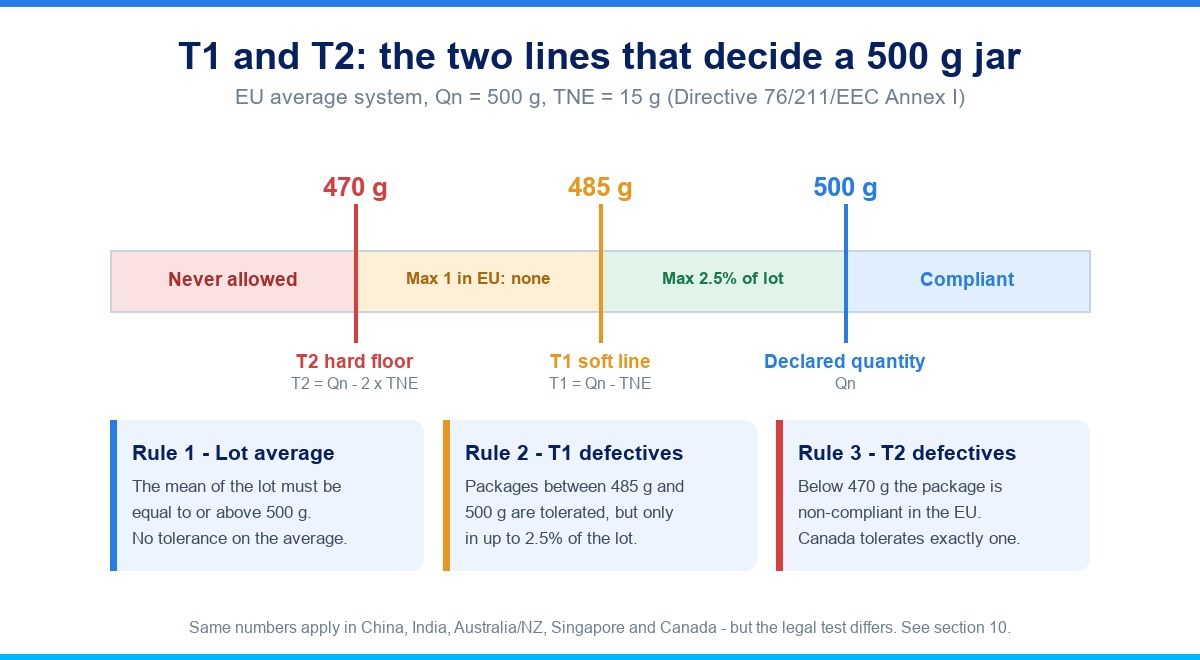
3.3 Worked example: a 500 g jar
For a 500 g pack, Qn sits in the 500–1000 band, so TNE = 15 g.
| Check | Value | Meaning |
|---|---|---|
| Nominal (Qn) | 500 g | Declared on the label |
| T1 line (Qn - TNE) | 485 g | Up to 2.5% of packs may fall below this |
| T2 floor (Qn - 2xTNE) | 470 g | No pack may fall below this, ever |
| Batch mean | ≥ 500 g | Rule 1, no tolerance on the average |
So a 500 g jar is fine at 488 g, which is under T1 and inside the 2.5% allowance. It is illegal at 468 g, below the T2 floor. And it is illegal at 482 g if more than 2.5% of the batch is that short.
3.4 Five names for the same number: a terminology map
The same concept travels under five different names, which is one reason cross-border compliance files contradict each other. Use this table when you read a foreign regulation or brief a translator.
| Term | Full name | Jurisdiction | What it limits | Legal character |
|---|---|---|---|---|
| TNE | Tolerable Negative Error | EU, AU/NZ (as AQS Table 2) | Shortfall of one pack below Qn | Soft line, 2.5% of batch may breach |
| MAV | Maximum Allowable Variation | United States (NIST HB 133) | Shortfall of one pack below declared weight | Per-item limit, relief via sampling plan |
| 允许短缺量 | Tolerable deficiency (yǔnxǔ duǎnquē liàng) | China (JJF 1070-2023) | Shortfall of one pack below Qn | Soft line, same 2.5% structure as the EU |
| 量目公差 | Quantity tolerance (ryōmoku kōsa) | Japan (Measurement Law) | Shortfall of one pack below declared quantity | Hard per-item line, no averaging |
| MPE | Maximum Permissible Error | India (LMPC Rules 2011) | Deviation of one pack in either direction | Hard per-item limit, over-fill included |
Read the middle column before you assume two numbers mean the same thing. A 500 g pack has a TNE of 15 g in the EU and an MPE of 15 g in India, and those two 15s behave nothing alike.
4. United States — NIST Handbook 133 and the MAV
The United States runs the one system on this list that never uses the word tolerance the way Europe does. There is no general allowance that lets a pack be short.
4.1 The two-rule test
Two requirements apply simultaneously:
- The average net quantity of the lot must be at least the declared amount.
- Individual packages must not show an unreasonable shortage, defined as a negative error greater than the Maximum Allowable Variation (MAV) for that declared quantity.
The MAV is the US equivalent of a per-item hard limit. Unlike the EU's TNE, it is not expressed as a soft line with a 2.5% exemption. The relief for individual variation comes from the sampling plan, which sets how many packs in a sample may exceed the MAV, not from a tolerance band.
4.2 Reading the MAV tables (2-5 to 2-9)
A Maximum Allowable Variation (MAV) is the largest shortfall a single package may have and still be legally acceptable. The MAV depends on the declared weight and the commodity category. NIST Handbook 133 (2026 Edition) assigns different tables by product type:
- Table 2-5 — general commodities labeled by weight (most FDA-regulated foods, drugs, cosmetics).
- Table 2-6 — liquid or dry volume.
- Table 2-7 — count.
- Table 2-8 — length, width, or area.
- Table 2-9 — USDA meat and poultry (different values, stricter in places).
The MAV values from Table 2-5 (2026 Edition) for weight-labeled packages. The four rows most exporters need are in bold.
| Declared weight | MAV (g) | MAV (oz) |
|---|---|---|
| < 36 g | 10% of declared | 10% of declared |
| 36–54 g | 3.6 g | 1/8 oz |
| 54–81 g | 5.4 g | 3/16 oz |
| 81–117 g | 7.2 g | 1/4 oz |
| 117–154 g | 9.0 g | 5/16 oz |
| 154–208 g | 10.8 g | 3/8 oz |
| 208–263 g | 12.7 g | 7/16 oz |
| 263–317 g | 14.5 g | 1/2 oz |
| 317–381 g | 16.3 g | 9/16 oz |
| 381–426 g | 18.1 g | 5/8 oz |
| 426–489 g | 19.9 g | 11/16 oz |
| 489–571 g | 21.7 g | 3/4 oz |
| 571–635 g | 23.5 g | 13/16 oz |
| 635–698 g | 25.4 g | 7/8 oz |
| 698–771 g | 27.2 g | 15/16 oz |
| 771–852 g | 29.0 g | 1 oz |
| 852–970 g | 31.7 g | 1-1/8 oz |
| 970 g–1.12 kg | 35.3 g | 1-1/4 oz |
| 1.12–1.25 kg | 39.0 g | 1-3/8 oz |
| 1.25–1.45 kg | 42.6 g | 1-1/2 oz |
| 1.45–1.76 kg | 49 g | 1-3/4 oz |
| 1.76–2.13 kg | 54 g | 1-7/8 oz |
| 2.13–2.63 kg | 63 g | 2-1/4 oz |
| 2.63–3.08 kg | 68 g | 2-3/8 oz |
| 3.08–3.58 kg | 77 g | 2-3/4 oz |
| 3.58–4.26 kg | 86 g | 3 oz |
| 4.26–5.30 kg | 99 g | 3-1/2 oz |
| 5.30–6.48 kg | 113 g | 4 oz |
| 6.48–8.02 kg | 127 g | 4-1/2 oz |
| 8.02–10.52 kg | 140 g | 5 oz |
| 10.52–14.33 kg | 167 g | 5-7/8 oz |
| 14.33–19.23 kg | 199 g | 7 oz |
Note the gap versus the EU. A 500 g pack has a US MAV of 21.7 g but an EU TNE of only 15 g. The US MAV is more generous per pack, yet the US gives you no 2.5% soft band and no averaging-away. The two systems are not comparable by the number alone.
4.3 Unreasonable errors, moisture allowance, and the "gray area"
Beyond the two-rule test, HB 133 recognises that some variation is unavoidable:
- Moisture loss or gain is permitted where ordinary distribution exposes the product to customary conditions. EPA pesticides are the exception, with no moisture loss recognised.
- The "gray area" is the zone between declared weight minus MAV and declared weight itself. A pack in that zone is legally fine. But a checkweigher set exactly at the MAV boundary is operationally risky, because instrument uncertainty will reject some good packs and pass some bad ones. Best practice sets the reject limit inside the MAV, typically at 50–75% of MAV, to build a control buffer.
5. China — JJF 1070-2023 and SAMR Order No. 70
Numerically, China is the EU. Legally, it is not, and the difference is a mark you have probably never heard of.
5.1 The 允许短缺量 (tolerable deficiency) table
JJF 1070-2023, Rules of Metering Testing for Net Content of Prepackaged Commodities with Fixed Content, replaced the 2005 version and took effect on 2024-10-12 (not 2023, a common citation error). SAMR Order No. 70, the Measures for the Supervision and Administration of Metrology of Prepackaged Commodities with Fixed Content, has been in force since 2023-06-01.
The nine rows below are the same ladder as the EU table in Section 3.2. Read 5.2 before you assume that makes an EU line ready to ship.
| Nominal quantity Qn (g or ml) | 允许短缺量 (tolerable deficiency) |
|---|---|
| 0–50 | 9% of Qn |
| 50–100 | 4.5 g |
| 100–200 | 4.5% of Qn |
| 200–300 | 9 g |
| 300–500 | 3% of Qn |
| 500–1000 | 15 g |
| 1000–10000 | 1.5% of Qn |
| 10000–15000 | 150 g |
| > 15000 | 1% of Qn |
The three-rule test mirrors the EU: batch mean ≥ Qn, no more than 2.5% of packs may breach T1, and no pack may breach T2. For an exporter, the practical takeaway is that a line already running to EU ℮ settings is also compliant with Chinese numbers. The trap is never the table. It is the paperwork and the C mark.
5.2 The "C" mark — a Chinese-only instrument
China adds a device-level credential found nowhere else: the C mark (计量保证能力合格标志, "Measurement Assurance Capability" mark) under SAMR Order No. 70. A manufacturer that passes the audit may apply the C mark to the prepackaged products covered by it, signalling an audited in-house measurement-assurance system. It is not the same as the EU ℮-mark and has no mutual recognition abroad. For selling into China it is a credibility signal worth having, and one your Chinese buyer's quality manager will recognise.
6. Japan — Measurement Law (計量法) and 量目公差
Japan is the market most likely to surprise you, because it uses a minimum-quantity system and splits the tolerance by commodity class. There are three tolerance tables under the Measurement Law (計量法, Act No. 51 of 1992) for specified prepackaged commodities across 29 specified commodity categories, not the single ladder other markets use.
6.1 Three tables, not one ladder
- Table 1 (mass) — meat, tea, confectionery, rice, and similar.
- Table 2 (mass) — fish, vegetables, fruit, and ready-to-eat foods.
- Table 3 (volume) — liquid commodities by volume.
Tables 1 and 2 are shown below. Table 3 is set separately under the same law.
Japan tolerance Table 1 — meat, tea, confectionery, rice (mass):
| Nominal quantity Qn (g) | 量目公差 (tolerance) |
|---|---|
| 5–50 | 4% of Qn |
| 50–100 | 2 g |
| 100–500 | 2% of Qn |
| 500–1000 | 10 g |
| 1000–25000 | 1% of Qn |
Japan tolerance Table 2 — fish, vegetables, fruit, ready-to-eat (mass):
| Nominal quantity Qn (g) | 量目公差 (tolerance) |
|---|---|
| 5–50 | 6% of Qn |
| 50–100 | 3 g |
| 100–500 | 3% of Qn |
| 500–1500 | 15 g |
| 1500–10000 | 1% of Qn |
6.2 One line, two set points
Two things jump out. First, Japan's percentages are tighter than OIML R87 in the small bands, at 4% and 6% against the EU's 9%. Second, the commodity split means a 500 g pack of tea (Table 1) tolerates 10 g, but a 500 g pack of fish (Table 2) tolerates 15 g.
A single production line serving both categories therefore needs two different checkweigher set points, selected by product code rather than by pack size. Japan also permits no averaging. Every pack must meet its class tolerance on its own.
7. India — Legal Metrology (Packaged Commodities) Rules 2011
India uses the same OIML R87 numbers as the EU, China, and Australia, but applies them as an individual hard limit in both directions. This is the single most common export failure we see.
7.1 The MPE table (First Schedule)
The nine rows below are identical to the EU table in Section 3.2. Read 7.2 before you use them.
| Nominal quantity Qn (g or ml) | Maximum Permissible Error (MPE) |
|---|---|
| 0–50 | 9% of Qn |
| 50–100 | 4.5 g |
| 100–200 | 4.5% of Qn |
| 200–300 | 9 g |
| 300–500 | 3% of Qn |
| 500–1000 | 15 g |
| 1000–10000 | 1.5% of Qn |
| 10000–15000 | 150 g |
| > 15000 | 1% of Qn |
7.2 Why "in excess or deficiency" changes everything
LMPC Rule 2(e) defines the MPE as the limit for the individual package. Rule 22 and the declaring rules make the MPE apply "in excess or in deficiency." That means:
- A pack that is over-filled beyond the MPE is just as non-compliant as one that is under-filled.
- There is no 2.5% allowance and no 2x TNE concept. The MPE is the per-item hard limit for every single pack.
- An ℮-tuned line, which allows 2.5% of packs to dip to T1 and assumes over-fill is economically harmless, will systematically violate LMPC on the over-fill side.
The fix is rarely the filling machine. It is the checkweigher reject logic. Set the upper reject limit at Qn + MPE, not just the lower limit at Qn - MPE, and the same line becomes India-compliant.
8. Australia & New Zealand — NMI Average Quantity System
This is the short section, and that is the point.
Australia and New Zealand share a single average-quantity framework administered by the National Measurement Institute (NMI). The tolerances in Table 2 of the AQS are identical to the EU ladder, and the sampling and control rules in Table 1 encode the same three packer's rules.
| Nominal quantity Qn (g or ml) | Tolerable negative error (AQS Table 2) |
|---|---|
| 0–50 | 9% of Qn |
| 50–100 | 4.5 g |
| 100–200 | 4.5% of Qn |
| 200–300 | 9 g |
| 300–500 | 3% of Qn |
| 500–1000 | 15 g |
| 1000–10000 | 1.5% of Qn |
| 10000–15000 | 150 g |
| > 15000 | 1% of Qn |
The legal basis is the National Trade Measurement Regulations 2009, regulation 4.36, reinforced by the three packer's rules in NMI's AQS guidance. For random-weight goods such as meat, cheese and seafood sold by weight, Australia uses a separate catch-weight approach: the average of the declared weights across the batch must hold, and individual packs stay within their own brackets. For how that plays out on a real line, see weigh price labelling and catchweight packages.
Australia and New Zealand are the one entry on this list where "same table" really does mean "same law." If your line is ℮-compliant, it is AQS-compliant. Bank that, and spend your attention on the other six.
9. Canada — Weights and Measures Act and Measurement Canada
Canada breaks the "same table" pattern in a subtle way. It uses the OIML R87 ladder for non-catch-weight goods under Part III of Schedule I, but it is a dual-regulation regime, and it is slightly more lenient than the EU on the worst-case pack.
9.1 The three Competition Bureau rules
The legal basis is the Consumer Packaging and Labelling Act s.7(3) and the Consumer Packaging and Labelling Regulations s.38, s.39, and Schedules I and II. The test has three parts:
- The weighted lot average must be at least the declared quantity (no tolerance on the average).
- No more than 2.5% of the lot may have a negative error greater than the tolerance.
- Under s.39(4)(c), if two or more packages have a negative error greater than twice the tolerance, the lot fails. At most one T2 defective is allowed.
That third rule is the Canada-specific nuance: the EU allows zero T2 defects, while Canada allows one. It is a narrow difference, but it is the kind of detail that decides a borderline audit.
9.2 The tolerance tables (Part III non-catch-weight)
Same nine rows again. See 9.1 for the one-defective difference that makes them behave differently.
| Nominal quantity Qn (g or ml) | Tolerance (Part III) |
|---|---|
| 0–50 | 9% of Qn |
| 50–100 | 4.5 g |
| 100–200 | 4.5% of Qn |
| 200–300 | 9 g |
| 300–500 | 3% of Qn |
| 500–1000 | 15 g |
| 1000–10000 | 1.5% of Qn |
| 10000–15000 | 150 g |
| > 15000 | 1% of Qn |
Part I of Schedule I covers catch-weight (random-weight) prepackaged products, defined in s.38(1). These are goods packed without a fixed content, such as block cheese or variable-weight meat, where the declared quantity is itself a labelled average. Part I sets its own brackets and is administered alongside the food-safety rules of the Canadian Food Inspection Agency (CFIA). The device-approval side is handled separately by Measurement Canada (see Section 12).
Mini-story 2 — the one cheese block that was legal in Ontario and illegal in Rotterdam. A Canadian dairy packer, call him Tom, ran 500 g fixed-weight cheese blocks for the domestic market. Part III of Schedule I puts the tolerance at 15 g, so the hard floor is 470 g, and s.39(4)(c) only fails a lot when two or more blocks fall below it. Tom's line produced about one such block per lot. For eleven years that was legal, it was audited as legal, and nobody had any reason to change it. Then the first container went to Rotterdam on the same settings. The inspection found one block at 468 g. Under 76/211/EEC the number that fails a batch is not two. It is one. Tom had not changed anything, drifted anywhere, or cut a corner. He had crossed a border carrying a set point that was tuned to a rule which did not travel with it.
10. Same Table, Different Law: the Trap in Net Content Tolerance by Country
Here is the whole argument in one matrix. Five jurisdictions share the OIML R87 numbers. Only the columns on the right decide whether you ship or get seized.
10.1 What is identical
Five of the seven markets in this article, the EU, China, India, Australia/NZ and Canada, publish the same nine rows: 9% → 4.5 g → 4.5% → 9 g → 3% → 15 g → 1.5% → 150 g → 1%. The UK and Singapore publish them too. If you have ever wondered why a tolerance you memorised for one market keeps reappearing in another, this is why. They all descend from OIML R87, and none of them saw a reason to renumber it.
That is the good news, and it is why this article's tables look repetitive. The repetition is the finding.
| Jurisdiction | System | Mean ≥ Qn? | T1 short allowed? | T2 (2x) allowed? | Over-fill regulated? |
|---|---|---|---|---|---|
| EU | Average | Yes | ≤ 2.5% of batch | 0 | Only if ℮ used |
| China | Average | Yes | ≤ 2.5% of batch | 0 | No |
| Australia/NZ | Average | Yes | ≤ 2.5% of batch | 0 | No |
| Singapore | Average | Yes | ≤ 2.5% of batch | 0 | No |
| India | Individual limit | Per-item only | 0 | MPE is the hard line | Yes |
| US | Individual limit | Yes (no allowance) | Via sampling plan | 0 beyond MAV | No |
| Japan | Minimum | No averaging | 0 | 0 | No |
| Canada (Part III) | Average | Yes | ≤ 2.5% of lot | Max 1 | No |
10.2 What is not
Now the trap is visible. Tune a line to EU ℮ parameters and it will pass in China, in Australia and New Zealand, in Singapore, and, with the one-T2 nuance, in Canada. Four markets, no changes, no risk.
Send the output of that same line to India and it fails. Over-fill is a violation there, and there is no 2.5% slack to absorb the tail.
Send it to the United States and it is judged against a different table, under a sampling plan rather than a tolerance band.
Send it to Japan and it fails three ways at once: tighter percentages, a commodity split, and no averaging at all.
Same nine rows. Three verdicts. The rule that catches exporters is easy to state and hard to remember: never port a set point across a border. Port the method, then re-derive the set point.
11. From Tolerance to Scale Division: Sizing Checkweigher Accuracy
This is where regulation becomes hardware. The tolerance table tells you the legal line. The scale-division rule tells you the smallest graduation your checkweigher may have and still prove compliance. Different markets size the instrument differently.
For a step-by-step on putting these set points onto a real line, see how checkweighers are deployed on real packing lines.
11.1 The one-fifth principle: measurement error ≤ 1/5 of the TNE
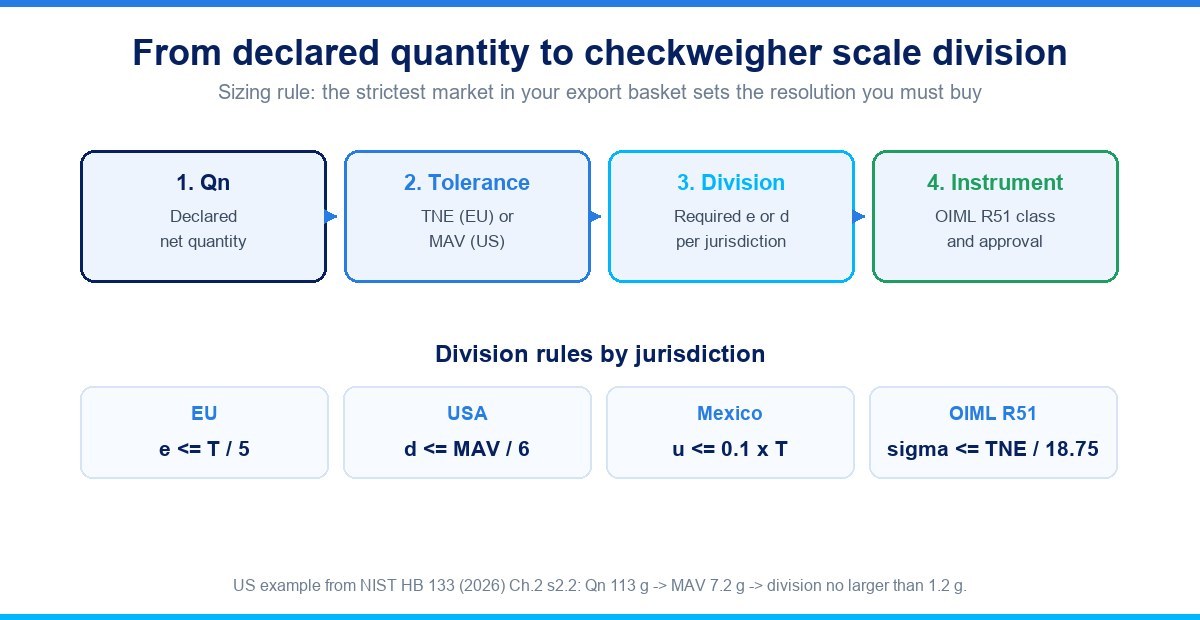
The average-quantity system assumes the instrument that judges a pack is materially better than the limit it is judging against. In practice that is expressed as a one-fifth rule: the checkweigher's measurement error must be no more than one fifth of the TNE, or e ≤ T ÷ 5.
Spain's RD 1801/2008, the national transposition of the EU average system, states it in the clearest terms of any Member State text. Article 13 sets the instrument's maximum permissible error (EMP) at no more than one fifth of the tolerable negative error: EMP(Qn) ≤ 1/5 × EMDT(Qn). Other Member States apply the same ratio through their own transpositions and inspection guidance, so treat it as the working number across the EU and confirm the local wording before an audit.
For a 500 g pack with a TNE of 15 g, the checkweigher error budget is 3 g, so you need a verification scale interval e ≤ 3 g.
11.2 The Mexican rule: instrument uncertainty ≤ 0.1 T
Mexico's NOM-002-SCFI-2011 is stricter than the EU by a factor of two. Article 7.1.3 requires that the uncertainty of the measuring instrument not exceed one tenth of the corresponding tolerance, or 0.1 T. Where the EU allows 1/5 T, Mexico allows only 1/10 T, so the same 500 g pack needs an instrument good to 1.5 g, not 3 g. If you serve the Latin American market, size for Mexico and the EU will follow.
11.3 The US approach under HB 133: d ≤ MAV ÷ 6
NIST Handbook 133 (2026 Edition), Chapter 2, sets the scale requirements for net-content verification. A scale used for the test must have at least 100 scale divisions and a scale division no larger than one sixth of the MAV, giving d ≤ MAV ÷ 6. The rule exists so the scale has enough resolution to judge a package against its MAV. The official worked example: a 113 g (0.25 lb) package has an MAV of 7.2 g, so the maximum allowable scale division is 7.2 ÷ 6 = 1.2 g.
This is the US counterpart to the EU's e ≤ T ÷ 5. Same purpose, which is proving the pack against the limit. Different constant, and anchored to the MAV rather than the TNE.
Upstream of the checkweigher, fill accuracy decides how much of the tolerance band you actually consume. For that lever, see semi-automatic combination weighers for filling accuracy.
11.4 How to choose a checkweigher scale division in four steps
- Find Qn. Take the nominal quantity exactly as it is declared on the label, in the unit it is declared in.
- Read the tolerance for that market. Use the TNE in the EU, China, Australia/NZ and Canada; the MAV in the United States; the 量目公差 for the correct commodity table in Japan; the MPE in India.
- Apply the market's sizing constant to get the division. EU: e ≤ T ÷ 5. United States: d ≤ MAV ÷ 6. Mexico: instrument uncertainty ≤ 0.1 T.
- Cross-check the instrument class. Confirm that the OIML R51 class X(1) weighing-result standard deviation stays under TNE ÷ 18.75.
Steps 3 and 4 are separate tests. Passing one does not pass the other.
11.5 Worked sizing table (Qn → T → required e → MAV → required d)
| Qn | EU TNE (T) | Required e ≤ T ÷ 5 | US MAV | Required d ≤ MAV ÷ 6 |
|---|---|---|---|---|
| 50 g | 4.5 g | ≤ 0.9 g | 3.6 g | ≤ 0.6 g |
| 100 g | 4.5 g | ≤ 0.9 g | 7.2 g | ≤ 1.2 g |
| 250 g | 9 g | ≤ 1.8 g | 12.7 g | ≤ 2.1 g |
| 500 g | 15 g | ≤ 3.0 g | 21.7 g | ≤ 3.6 g |
| 1 kg | 15 g | ≤ 3.0 g | 35.3 g | ≤ 5.9 g |
| 2 kg | 30 g | ≤ 6.0 g | 54 g | ≤ 9.0 g |
| 5 kg | 75 g | ≤ 15 g | 99 g | ≤ 16.5 g |
Where product is graded rather than simply passed or rejected, the adjacent category is weight sorting and grading equipment, which uses the same division arithmetic.
Mini-story 3 — the 5 g that failed a GUM audit. A Polish packing engineer we'll call "Anna" moved a checkweigher off a 5 kg product line onto a new 500 g line. Its verification scale interval was e = 5 g, fine at 5 kg, and, she reasoned, still comfortably inside the 15 g TNE at 500 g. At audit, the GUM inspector walked the math: the instrument error must be ≤ 1/5 × 15 g = 3 g, and a 5 g interval cannot demonstrate that a pack near the 485 g line is genuinely above or below it. The instrument's own spread swamps the legal error budget. The line was re-specced to e = 2 g and the audit passed. Anna's team adopted the "size from T ÷ 5, not from T" rule plant-wide. The failed lot cost one shipment. The fix cost one instrument specification, and it should have been free, because the number was available before anyone signed a purchase order.
12. Checkweigher Approval and Accuracy Requirements by Jurisdiction
The tolerance tells you the line; the approval tells you whether the instrument is legal to use. Buyers searching for checkweigher accuracy requirements MID, NTEP or JJG usually find marketing pages rather than the rule. This is the table procurement teams search for and rarely find.
12.1 EU — MID 2014/32/EU Annex VIII (MI-006)
Automatic weighing instruments, which include in-motion checkweighers, are governed by the Measuring Instruments Directive 2014/32/EU, Annex VIII, module MI-006 ("Automatic weighing instruments"), aligned to OIML R51 and R61. MID Module MI-006 sets the checkweigher accuracy requirements a legal-for-trade instrument must meet, and a compliant machine carries CE and MID marking.
Correction worth bookmarking: a common industry citation error is to call checkweighers "MI-005." MI-005 is for liquid continuous dynamic measuring systems, meaning fuel dispensers under OIML R117, not weighers. Checkweighers are MI-006. Writing MI-005 in a spec or tender is the fastest way to lose credibility with a European metrology reviewer. (Source: legislation.gov.uk eudr/2014/32/annex/VIII/adopted; WELMEC Guide CT-006-II.)
12.2 OIML R 51 accuracy classes X / Y
OIML R51 sorts automatic checkweighers into accuracy classes by their weighing-result performance:
- X classes (XI, XII, XIII, XIIII) — used for quantitative pre-packaging control, meaning the checkweigher that decides pass or reject.
- Y classes (Y(I), Y(II), Y(a), Y(b)) — used for weight-price labelling and similar.
For a class X(1) checkweigher, the maximum permissible standard deviation of the weighing result must be held to roughly TNE ÷ 18.75 in every OIML R87 band. In other words, the instrument's own spread must be tiny compared with the legal tolerance:
| OIML R87 band (TNE) | Max permissible weighing-result σ (class X(1)) |
|---|---|
| 9% of Qn | 0.48% of Qn |
| 4.5 g | 0.24 g |
| 4.5% of Qn | 0.24% of Qn |
| 9 g | 0.48 g |
| 3% of Qn | 0.16% of Qn |
| 15 g | 0.80 g |
| 1.5% of Qn | 0.08% of Qn |
| 150 g | 8.0 g |
| 1% of Qn | 0.053% of Qn |
This is the cross-check that links the tolerance table to the device spec. Whatever e ≤ T ÷ 5 gives you, the weighing result must also stay under TNE ÷ 18.75. For the full class breakdown, see checkweigher accuracy classes under OIML R 51.
12.3 United States — NTEP and NIST Handbook 44
In the US, a legal-for-trade checkweigher needs an NTEP Certificate of Conformance (CC). The certificate is issued by the National Conference on Weights and Measures on the basis of NIST Handbook 44, the Specifications, Tolerances, and Other Technical Requirements for Weighing and Measuring Devices.
Scales section §2.20 and belt-conveyor section §2.21 govern the device. Handbook 133 governs the net-content test. NTEP and OIML MAA load cells are generally accepted, but there is no US-Canada mutual-recognition agreement, so a US NTEP certificate does not auto-approve a device for Canada.
12.4 China — JJG 539 and JJG 648
China pattern-approves weighing instruments under its metrological verification regulations:
- JJG 539 — verification regulation for electronic weighing instruments, the general device class.
- JJG 648 — verification regulation specifically for automatic checkweighers (分选秤 / 重量选别秤).
A checkweigher sold or used in China for trade needs pattern approval and, where applicable, the manufacturer's CMC (制造计量器具许可, manufacturing licence).
12.5 AU/NZ, Japan, India, and Canada
| Jurisdiction | Approval / mark | Governing basis |
|---|---|---|
| EU | MID MI-006 (CE + MID) | Dir. 2014/32/EU Annex VIII; OIML R51 |
| United States | NTEP Certificate of Conformance | NIST HB 44; NCWM |
| China | JJG 539 / JJG 648 pattern approval + CMC | SAMR verification regulations |
| Australia/NZ | NMI pattern approval | National Measurement Act 1960 |
| Japan | Pattern approval under Measurement Law | METI / JCSS |
| India | LMPC model approval | Legal Metrology Act 2009 |
| Canada | Measurement Canada Notice of Approval | Weights and Measures Act; accepts NTEP CC / OIML MAA load cells per M-25 bulletin |
To see the full equipment range these approvals cover, browse our full range of checkweighing and inspection equipment.
13. Net Content Tolerance by Country: the Exporter's Compliance Checklist
Use this net content tolerance-by-country checklist before you set a single set point. A printable checklist. Save it before you close the tab.
| # | Check | Why it matters |
|---|---|---|
| 1 | Identify the target market's legal family (average / individual / minimum) | Decides whether averaging can save you |
| 2 | Pull the local tolerance table, not the EU one | India, the US and Japan differ in number or direction |
| 3 | EU/China/AU/NZ/Canada: confirm batch mean ≥ Qn and ≤ 2.5% below T1 | The three packer's rules |
| 4 | India: set both upper and lower reject limits at Qn ± MPE | Over-fill is regulated |
| 5 | US: size scale division to d ≤ MAV ÷ 6; confirm NTEP CC | HB 133 Ch. 2 scale requirements |
| 6 | Japan: pick the correct commodity table (1, 2, or 3) and forbid averaging | Tighter percentages; class split |
| 7 | Mexico/LatAm: instrument uncertainty ≤ 0.1 T | Twice as strict as the EU |
| 8 | Canada: remember max one T2 defective (s.39(4)(c)) | Differs from the EU's zero |
| 9 | Size checkweigher to e ≤ T ÷ 5 (EU) and verify σ ≤ TNE ÷ 18.75 (OIML R51 X(1)) | Proves the legal line |
| 10 | Confirm device approval for the market (MID MI-006 / NTEP / JJG 539-648 / NMI / Measurement Canada) | Illegal device = illegal pack |
| 11 | Keep fill and check records for the audit window | Inspectors ask for both |
For the parallel detection layer, meaning foreign bodies and fill-level control that sit alongside net-content checks, see X-ray inspection for foreign body and fill-level control.
Before you close this tab. Nothing in the six tolerance tables above disagrees with anything else. They agree almost perfectly, and that agreement is exactly what gets shipments seized. Read the law, not the number.
14. FAQ: Net Content Tolerance by Country
What is the tolerable negative error for a 500 g package? For a 500 g pack the TNE is 15 g (500–1000 band). At least 485 g is required for up to 2.5% of the lot, and no pack may fall below 470 g (2x TNE). This holds for the EU, China, Australia/NZ, and Canada's non-catch-weight goods.
How much can a package be underweight legally? It depends on the market's legal family. Average-system markets (EU, China, AU/NZ, Canada) allow up to 2.5% of packs to dip to the TNE and none below 2x TNE. Individual-limit markets (US, India) judge every pack against its MAV or MPE with no averaging relief.
Is the ℮-mark mandatory in the EU? No. The ℮-mark is voluntary. But once you print it, you accept full legal liability under 76/211/EEC and 2007/45/EC for running a verified average-quantity system. You can pack to the same numbers without the mark.
What is the difference between the average-quantity and minimum-quantity systems? Average systems (EU, China, AU/NZ, Canada) let a few packs be short as long as the batch mean holds and no pack is doubly short. Minimum systems (Japan) require every pack to meet its tolerance with no averaging allowed.
Does the US have a net content tolerance? Not in the EU sense. NIST Handbook 133 sets no general tolerance; instead the lot average must meet the declaration and no individual pack may be short by more than its MAV. The relief for variation comes from the sampling plan, not a tolerance band.
What is MAV in NIST Handbook 133? A Maximum Allowable Variation (MAV) is the largest shortfall a single package may have and still be acceptable. It is set per declared weight and commodity type in HB 133 Tables 2-5 to 2-9 (for example, 21.7 g for a 500 g general commodity).
What changed in JJF 1070-2023 versus 2005? JJF 1070-2023 updated China's net-content test rules and took effect on 2024-10-12, replacing the 2005 version. SAMR Order No. 70 (in force 2023-06-01) governs the C mark and supervision. The tolerance numbers themselves are unchanged from the OIML R87 ladder.
What is the tolerance for a 1 kg package in China? A 1 kg (1000 g) pack falls in the 1000–10000 band, so the 允许短缺量 is 1.5% = 15 g. The soft line is 985 g (up to 2.5% of packs) and the hard floor is 970 g.
Do I need a MID-approved checkweigher for ℮ packing? If the checkweigher is used for legal trade (pass/reject on the ℮ line) in the EU, it should be approved under MID 2014/32/EU Annex VIII (MI-006) and carry CE + MID marking. MI-005 is for fuel dispensers, not weighers.
How do I choose a checkweigher scale division for a tolerance? Four steps: (1) find Qn; (2) read the TNE or MAV; (3) in the EU set e ≤ T ÷ 5, in the US set d ≤ MAV ÷ 6, in Mexico require uncertainty ≤ 0.1 T; (4) confirm the OIML R51 X(1) weighing-result σ stays under TNE ÷ 18.75.
What is the tolerable deficiency in Australia's AQS? Australia's Average Quantity System Table 2 gives the same ladder as the EU: 15 g for a 500 g pack, 1.5% (15 g) for 1 kg, and so on, with the three packer's rules enforced via NMI guidance.
Why does net content tolerance by country differ when the table looks identical? The numbers are identical because most markets copied OIML R87, but the legal effect is not. India applies the MPE as a per-item hard limit in both directions with no 2.5% slack and no 2x concept, so an EU-compliant line is not automatically India-compliant.
15. Sources and Document Versions
Every figure above traces to a primary or official source. Links go to government or standards-body pages only. Three sources are cited as plain text because their official sites block requests from some regions; the regulation name and year are given so you can retrieve them locally.
| # | Regulation / document | Jurisdiction | Version / effective date | Official source | Link check (2026-08-05) |
|---|---|---|---|---|---|
| 1 | Directive 76/211/EEC → 2007/45/EC | EU | 76/211/EEC (1976); 2007/45/EC (eff. 2009-01-01, full 2010-01-01) | EUR-Lex CELEX:32007L0045 | 200 |
| 2 | WELMEC Guide 6.4 (Packaged Goods) | EU | 2015 edition | WELMEC 6.4 (2015) PDF | 200 |
| 3 | NIST Handbook 133 (Net Contents) | US | 2026 Edition, Chapter 2 | NIST HB 133-2026 PDF | 200 |
| 4 | NIST Handbook 44 (device specs) | US | 2026 Edition (NCWM model regulations) | NIST HB 44 edition page | 200 |
| 5 | JJF 1070-2023 | China | eff. 2024-10-12 | National metrology technical regulation full-text system | 200 |
| 6 | SAMR Order No. 70 | China | eff. 2023-06-01 | SAMR official text | 200 |
| 7 | Measurement Law (計量法), Act No. 51 | Japan | 1992, as amended | e-Gov 計量法 404AC0000000051 | 200 |
| 8 | LMPC Rules 2011, First Schedule | India | 2011, as amended | Dept. of Consumer Affairs, Legal Metrology Rules | 200 |
| 9 | National Trade Measurement Regulations 2009, reg 4.36 | AU/NZ | 2009 | legislation.gov.au F2009L04530 | 200 |
| 10 | Consumer Packaging and Labelling Act s.7(3) + Regs s.38/39, Sched. I | Canada | C.R.C., c. 417; Competition Act R.S.C. c. C-38 | CPLA Regs C.R.C. c.417 · Competition Act C-38 | 200 |
| 11 | Weights and Measures (Defences under s.19) Regulations 2022, First Schedule | Singapore | 2022 | Plain text. Singapore Statutes Online (sso.agc.gov.sg) blocks requests from some regions; search the regulation name and year on that site. | Geo-blocked, not linked |
| 12 | MID 2014/32/EU, Annex VIII (MI-006) | EU | 2014/32/EU | legislation.gov.uk eudr/2014/32 Annex VIII | 200 |
| 13 | OIML R 51 (automatic checkweighers) | International | R 51-1:2006 | OIML R 51-1:2006 PDF | 200 |
| 14 | NOM-002-SCFI-2011 | Mexico | 2011 (DOF, 06-04-2011) | DOF nota_detalle codigo 5185011 | 200 |
Two further sources are cited in the text as plain text for the same reason. Australia's NMI Average Quantity System guide (measurement.gov.au) is region-restricted, so the regulation itself is linked at row 9 instead. Japan's METI metrology pages (meti.go.jp) are region-restricted, so the e-Gov statute at row 7 is used instead.
External references:
- NIST Handbook 133 (2026 Ed.), MAV tables
- Australia AQS: the regulation is at legislation.gov.au F2009L04530. The NMI AQS guide site is region-restricted, so cite the legislation rather than the guide.
- EU ℮-mark: Directive 2007/45/EC. This is the ℮-mark law, which is a different instrument from CE marking.
- OIML R 87:2016, Quantity of product in prepackages
This article is informational and does not constitute legal advice. Net-content and device-approval rules change; always confirm the current text with the responsible authority (SAMR, NIST, METI, Legal Metrology or state authorities, NMI, Competition Bureau or Measurement Canada, or your local metrology body) before shipping. Figures are compiled from official sources listed above; where a market uses commodity-specific or random-weight tables, consult the primary regulation directly.
Written by SameGram's metrology engineering team. SameGram Equipment Co., Ltd. builds checkweighers, metal detectors and X-ray inspection systems for export-oriented food and pharmaceutical lines. Deriving set points against MID, NTEP, JJG and NMI requirements is part of every project we ship. About SameGram · More articles on weighing compliance
If you need net content tolerance by country calculated for a specific market and pack size, our metrology engineers will run it with you. Talk to our metrology engineering team, or request a compliance assessment for your target market.