



Dynamic Checkweigher Line Integration: Space & Alignment Guide
Adding an in-line dynamic checkweigher to an existing or newly planned packaging line rarely fails because of the load cell electronics alone. In real-world factory retrofits across food processing, pharmaceuticals, personal care, and logistics, over 70% of early commissioning headaches—ranging from erratic weight readings to excessive false rejects and product tip-overs—trace back to mechanical and spatial mismatches on the shop floor.
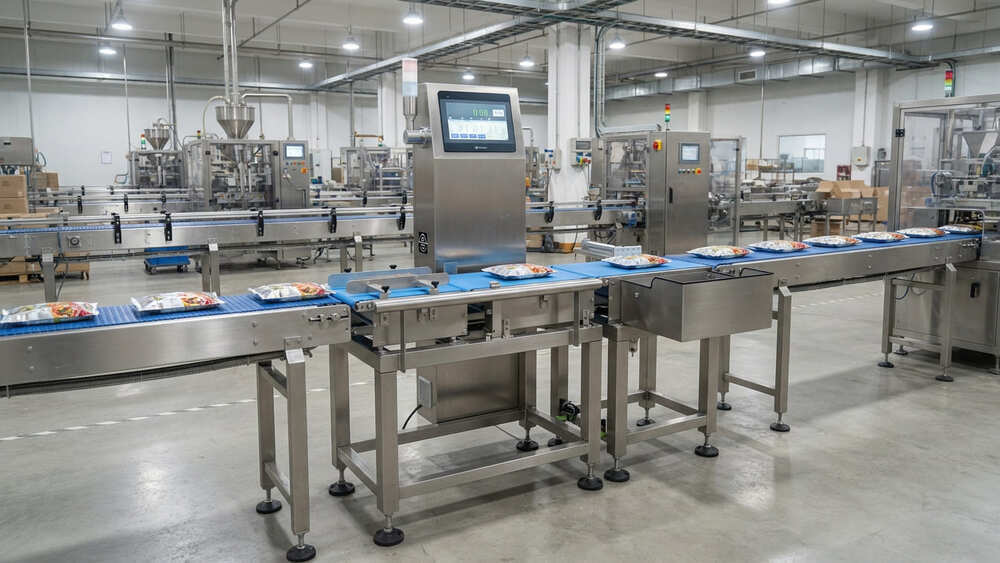
Unlike static bench scales where an operator places an item down and waits for equilibrium, a dynamic checkweigher has only milliseconds to capture a stable mass measurement while packages travel continuously at speeds reaching 60 to 300+ packs per minute. In that brief measurement window, every millimeter of transfer gap, every fraction of a degree in frame tilt, and every stray vibration from an adjacent conveyor motor translates directly into signal noise.
Whether you are retrofitting quality inspection into a space-starved legacy packaging line or drafting CAD layouts for a greenfield facility, getting the mechanical footprint right is non-negotiable. This engineering guide breaks down the four critical physical pillars of dynamic checkweigher integration—space planning, conveyor alignment, structural leveling, and vibration isolation—so your line achieves repeatable accuracy without sacrificing throughput.
1. Footprint & Space Planning: Fitting an In-Line Checkweigher into Tight Lines
One of the most frequent questions plant engineers ask during capital equipment planning is: 'What are the exact space requirements for an in-line checkweigher?' The short answer is that the physical length of the weighing conveyor itself represents less than half of the total linear space required for reliable operation.
The Three-Zone Linear Architecture
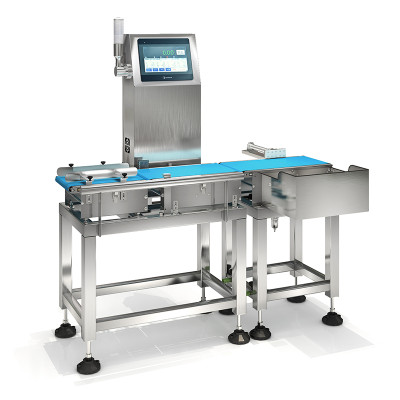
To isolate a single package from adjacent items and measure its true mass without interference, a dynamic checkweighing system requires three distinct mechanical zones:
● Infeed / Spacing Conveyor Zone: Before a package touches the weighing platform, it must be properly spaced (pitched) so that only one product occupies the weighing bed at any instant. If packages arrive back-to-back from an upstream wrapper or filler, the infeed section must run slightly faster than the upstream belt to pull a clean gap between consecutive items. Depending on product length and line speed, this section typically requires 400 mm to 800 mm of linear run.
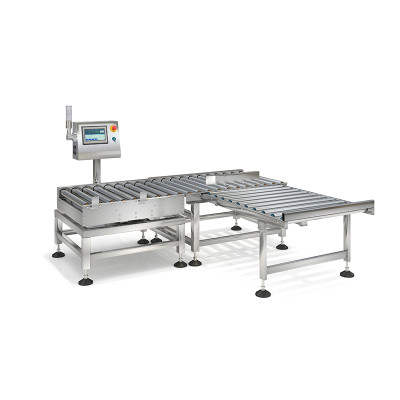
● Weighing Conveyor Zone: The weighing bed must be longer than the maximum product length—ideally at least 1.5 times the length of the longest package—to ensure the item rests completely on the scale deck for a sufficient settling and sampling duration. Compact high-speed units may feature a 300 mm to 500 mm weighing table, while heavy-duty carton or case checkweighers require 800 mm to 1,200 mm.
● Outfeed & Reject Zone: Once weighed, out-of-tolerance items must be diverted cleanly without colliding with downstream products. Whether utilizing an air-blast nozzle for lightweight pouches, a pneumatic pusher for rigid boxes, or a drop-flap mechanism, the outfeed conveyor needs 500 mm to 1,000 mm of unobstructed clearance plus side-access space for a lockable reject bin.
Overcoming Space Bottlenecks in Legacy Retrofits
In mature facilities where upstream form-fill-seal machines and downstream cartoners are already bolted to the floor, finding 1.8 to 2.5 meters of straight conveyor space can feel impossible. Rather than rerouting entire line sections, engineers can deploy compact, modular frame designs. At SameGram, our engineering team designs customizable compact checkweigher frames—including ultra-short footprint models and integrated combo units—tailored specifically to drop into tight legacy footprints without forcing major upstream relocations.
2. Conveyor Height, Speed Matching & Transfer Gap Alignment
Even if you carve out enough floor space, poor mechanical handoffs between existing conveyors and the checkweigher will ruin measurement repeatability. When a package transitions from an upstream belt onto the weighing deck, any abrupt step, gap, or speed mismatch injects vertical impact forces and horizontal shear stress directly into the load cell.
Controlling the Transfer Gap (The ≤10 mm Rule)
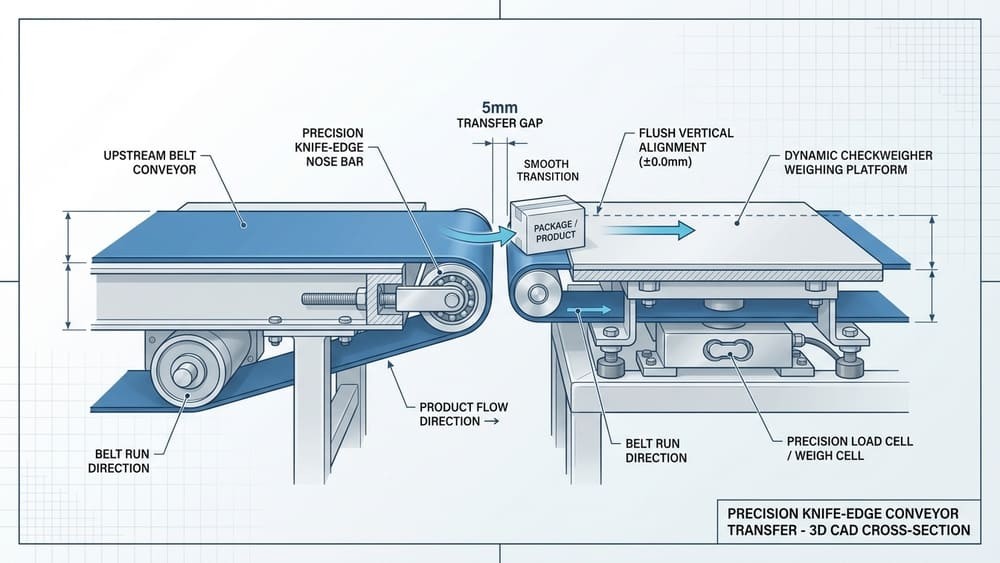
The physical gap between the upstream conveyor nosebar and the checkweigher infeed roller—as well as between the weighing deck and outfeed conveyor—must be kept as narrow as mechanically safe. In standard packaging applications, transfer gaps should not exceed 10 mm (and ideally stay between 3 mm and 6 mm for small or flexible pouches).
If the transfer gap is too wide, the leading edge of a package dips downward into the void before hitting the front roller of the weighing bed. That downward dip creates a mechanical 'thump' that triggers oscillation in the load cell signal, eating up precious milliseconds of the settling window. For small pharmaceutical cartons, blister packs, or unstable upright bottles, precision knife-edge (nosebar) transfers are essential to keep the center of gravity flat across the transition.
Conveyor Height & Coaxial Alignment
Vertical height alignment requires sub-millimeter discipline. The top surface of the checkweigher infeed belt should sit flush with—or at most 0.5 mm to 1.0 mm lower than—the upstream discharge conveyor. Never set the checkweigher higher than the upstream belt; an upward lip acts like a speed bump, causing lightweight packages to stub their leading edge, skew sideways, or tumble.
Equally critical is lateral coaxial alignment. The centerlines of the upstream conveyor, the checkweigher, and the downstream takeaway belt must form a straight line. If the checkweigher is offset laterally, guide rails have to force packages back toward the center. Side-rail friction during the weighing phase creates upward or downward drag forces that skew the weight reading—sometimes by several grams.
Dynamic Checkweigher Conveyor Speed Matching
Linear belt speed synchronization is where mechanical engineering meets process control. A common mistake during installation is setting the checkweigher belt speed identical to the upstream conveyor when packages are touching, or running the weighing belt significantly faster than the infeed belt.
● Upstream-to-Infeed Ratio: Run the checkweigher infeed belt 5% to 15% faster than the upstream discharge conveyor. This gentle acceleration pulls touching packages apart to establish a consistent pitch without jerking tall or unstable containers.
● Infeed-to-Weighing Ratio: The infeed conveyor and the weighing conveyor itself should run at virtually identical linear speeds (within ±1% to 2%). If the weighing belt accelerates a package while it is crossing the bridge, the resulting horizontal acceleration force transfers into the load cell structure and distorts zero-point stability.
● Weighing-to-Outfeed Ratio: Set the outfeed conveyor 2% to 5% faster than the weighing bed to clear weighed items briskly and create clean separation ahead of the reject station.
3. The Golden Rules of Mechanical Leveling & Foundation Rigidity
Load cells—whether high-speed strain gauge sensors or ultra-precise Electromagnetic Force Restoration (EMFR) modules—measure the vertical component of gravitational force ($F = m \cdot g \cdot \cos\theta$). When a checkweigher frame is tilted or twisted on an uneven factory floor, two things happen: the sensor measures only a cosine fraction of the true vertical load, and lateral torsional stress builds up inside the mechanical flexure.
Establishing a Rigid, Non-Deflecting Base
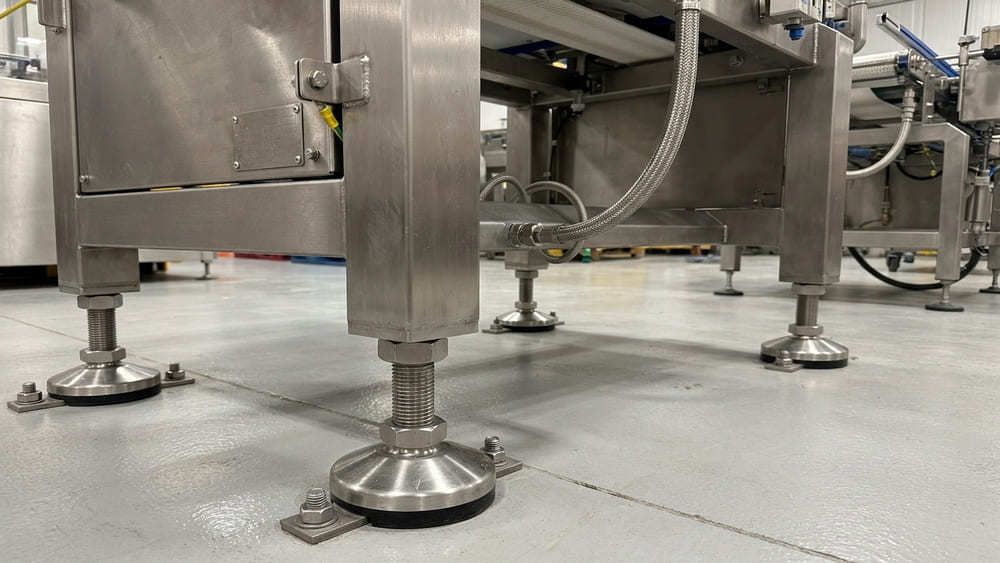
A dynamic checkweigher should never be installed on raised mezzanine grating, hollow steel decking, or flexible composite flooring that deflects when operators walk past or forklifts drive nearby. Install the machine directly onto a solid, reinforced concrete slab. All four (or six) stainless steel leveling feet must rest firmly on the floor with zero rocking before any locknuts are tightened.
Use a high-precision machinist spirit level (minimum sensitivity 0.05 mm/m) placed directly on the machined weighing frame—not on a flexible conveyor belt—to verify both longitudinal (infeed-to-outfeed) and transverse (side-to-side) levelness.
Critical Engineering Warning: Never Shim Under the Load Cell
During hurried line installations, technicians occasionally attempt to correct belt height discrepancies or frame tilt by inserting metal washers or shims directly beneath the load cell mounting block. This is one of the most destructive mistakes in dynamic weighing.
Shimming directly under a load cell introduces uneven clamping torque, twists the precision-machined mounting surfaces, and frequently creates a 'second load path' (mechanical shunting) where part of the package weight bypasses the sensing element altogether. All height and level adjustments must be performed exclusively via the main chassis leveling feet—or through proper machined sub-frame risers beneath the main machine legs.
4. Isolating Mechanical Vibration: Protecting the Load Cell
If you have ever watched a checkweigher display fluctuate wildly when no product is on the belt, you are witnessing structural or airborne vibration coupling into the weighing sensor. Modern dynamic checkweighers can resolve weight differences down to ±0.05 g or ±0.1 g, which means they are sensitive enough to detect floor harmonics from equipment several meters away.
Identifying and Isolating Floor-Borne Vibration
Heavy rotating and reciprocating machinery—such as air compressors, vacuum pumps, punch presses, high-speed cartoners, and large hydraulic motors—transmit low-frequency vibrations through concrete floor slabs. Whenever layout constraints allow, maintain at least 1.0 to 1.5 meters of physical clearance between the checkweigher frame and major vibration-generating machines.
When a checkweigher must sit beside a vibrating packaging machine, never bolt the checkweigher frame directly to the adjacent machine's chassis. Maintain a physical air gap of at least 10 mm to 20 mm between the checkweigher frame and upstream/downstream conveyors so mechanical vibrations cannot bridge across metal-to-metal contact points. Additionally, industrial elastomeric anti-vibration leveling pads beneath the machine feet help attenuate high-frequency floor chatter without compromising vertical frame rigidity.
Eliminating Conduit, Pneumatic & Guarding Bridges
Even when a checkweigher stands completely isolated on the floor, stray vibrations frequently sneak onto the frame through utility connections. Rigid electrical conduits, stiff compressed-air supply lines feeding the reject valve, or bolted safety tunnels connected to neighboring machines act like tuning forks.
● Use Flexible Utility Loops: Always connect compressed air hoses and electrical cabling to the checkweigher using flexible, slack loops rather than rigid piping clamped directly to the chassis.
● Isolate Draft Shields and Guide Rails: In pharmaceutical and lightweight pouch lines where air currents from HVAC vents or cooling fans disturb readings, enclose the weighing zone with an acrylic draft shield mounted strictly to the checkweigher's main stationary frame—never touching the floating weighing deck or adjacent conveyors.
5. How SameGram Engineers Checkweighers for Effortless Line Integration
At SameGram, we approach dynamic checkweighing not as an isolated box, but as an integral link in your end-to-end packaging and quality inspection ecosystem. Every SameGram dynamic checkweigher is engineered from the ground up to eliminate mechanical integration friction and survive demanding 24/7 industrial environments.
● Rigid 304/316 Stainless Steel Chassis & Tool-Free Belt Architecture: Our heavy-duty welded tubular frames minimize harmonic resonance at high belt speeds, while quick-release sanitary belts allow operators to strip, clean, and re-tension conveyors in minutes without disturbing load cell calibration.
● Adaptive Digital Filtering & High-Speed DSP: Paired with precision strain gauge and EMFR load cells, SameGram's proprietary digital signal processing algorithms actively filter out residual background conveyor vibrations, delivering dynamic accuracies up to ±0.1 g at speeds exceeding 200 packs per minute.
● Seamless Combo Integration (Checkweigher + Metal Detector): For facilities facing extreme floor-space constraints, SameGram offers integrated Checkweigher & Conveyor Metal Detector Combination Systems—merging foreign-body detection and 100% weight verification into a single ultra-compact footprint. [Internal Link Anchor: Discover SameGram Metal Detector & Checkweigher Combo Solutions]
● Application-Specific Engineering Across Industries: From IP65/IP66 washdown food lines to high-speed pharmaceutical cartoning and heavy logistics parcel sorting, our engineers customize belt widths, nosebar transfers, and reject mechanisms (air jet, pusher, flap, or drop-belt) to match your exact product geometry. Browse SameGram Industry Applications & Packaging Inspection Solutions
Verified Global Quality & Regulatory Compliance
Deploying inspection machinery across international manufacturing plants requires strict adherence to electrical safety, electromagnetic compatibility (EMC), and environmental standards. SameGram inspection systems are independently tested and certified to meet global regulatory benchmarks:
● CE Machinery & Safety Compliance: Verified under CE Certification for Dynamic Checkweighers (https://www.samegram.com/certificate/cid1770705/CE-certificate-of-checkweighers.htm) as well as combined EMC, Machinery Directive (MD), and Low Voltage Directive (LVD) compliance (https://www.samegram.com/certificate/cid1771507/SameGram-Conveyor-Metal-Detector-EMC-MD-LVD-Certification.htm).
● Metrological & International Conformity: Backed by ICR Conformity Verification for Weighing & Weight Inspection Equipment (https://www.samegram.com/certificate/cid1771722/ICR-certificate-of-Weighing-Weight-Inspection-Equipment.htm) and UDEM International Certification (https://www.samegram.com/certificate/cid1771690/SameGram-Conveyor-Metal-Detector-UDEM-Certification.htm).
● Environmental & RoHS Standards: Manufactured in full compliance with RoHS hazardous substance restrictions (https://www.samegram.com/certificate/cid1771508/SameGram-Conveyor-Metal-Detector-ROHS-Certification.htm). View our complete portfolio of quality credentials on the SameGram Official Certifications Hub (https://www.samegram.com/certificate.htm).
6. Pre-Installation Mechanical Audit Checklist for Plant Engineers
Before scheduling factory acceptance testing (FAT) or shipping a dynamic checkweigher to your facility, run through this quick engineering verification matrix to prevent costly installation delays:
| Integration Parameter | Engineering Target / Tolerance | Risk if Ignored | ||
Transfer Gap Width | ≤ 10 mm (3–6 mm for small pouches) | Package dipping, impact spikes, signal noise | ||
Vertical Step Alignment | Flush to -1.0 mm step-down onto scale | Leading-edge stubbing, product tip-overs | ||
| Belt Speed Ratio | Infeed +5–15% vs. upstream; Scale = Infeed | Product collision or horizontal shear error | ||
| Frame Levelness | ≤ 0.05 mm/m on reinforced concrete slab | Cosine gravity error & load cell torsion | ||
| Vibration Clearance | ≥ 1.0 m from heavy motors; ≥ 10 mm air gap | Zero-point drift & erratic false rejects | ||
Ready to Eliminate Integration Bottlenecks on Your Production Line?
Successful dynamic checkweigher integration starts long before power is applied to the control cabinet. By respecting linear spacing zones, keeping transfer gaps under 10 mm, matching conveyor belt speeds, leveling the chassis on solid concrete, and isolating external vibrations, your engineering team can lock in repeatable weighing accuracy from day one.
Planning a line upgrade or struggling to fit precision weight inspection into a tight space? Send your product dimensions, target line speed (PPM), and current conveyor layout drawings to the SameGram applications engineering team. We will provide a custom CAD footprint recommendation and tailored checkweigher specification built for seamless integration.
Author: Tony, Founder & CTO, SameGram
“At SameGram, every innovation starts with listening — to machines, to data, and most importantly, to our customers.”
Hot-Sale Dynamic Checkweigher
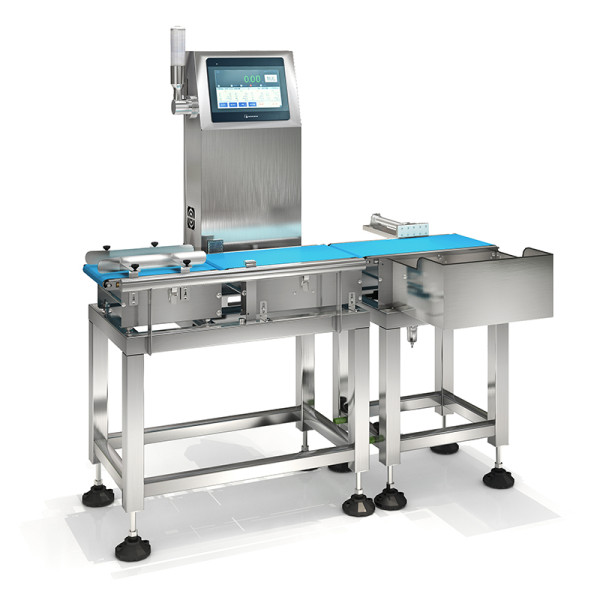
SCF-4523L3 is a hygienic food checkweigher with high precision and hi speed checkweighing for food industry,easy to integrate
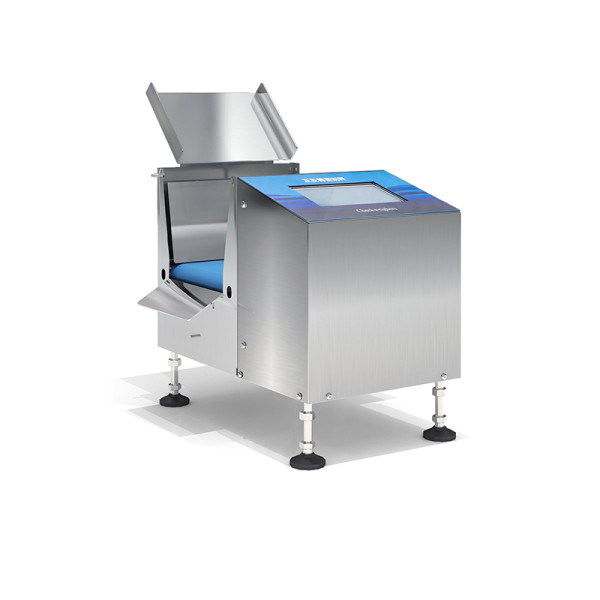
SC1-C-3523L1 has positive and negative weight selection,compact and economical. very suitable checkweigher for small packages.
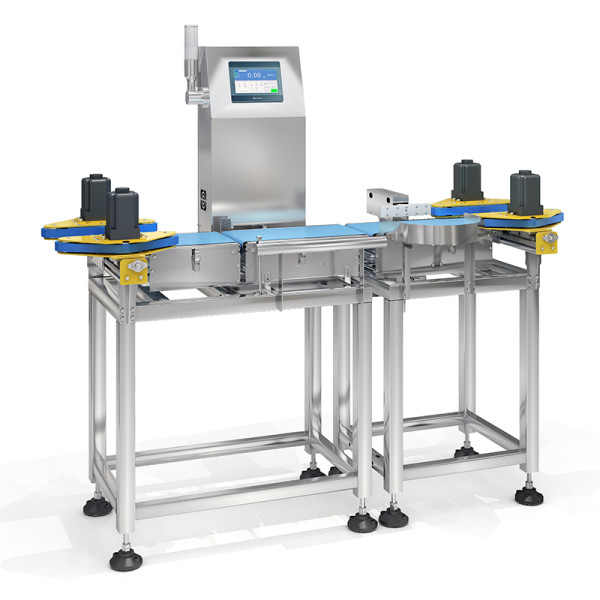
SC-C is a can checkweigher designed for cans,jars and bottles,which is a reliable online checkweigher for production line.
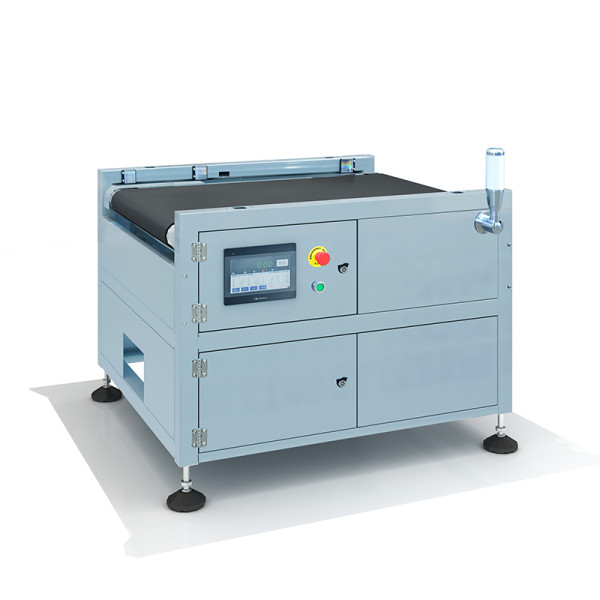
SC3-L-12080S60 is one of the best parcel weighing scales for large-items up to 60kg.,which can be integrated into DWS system.
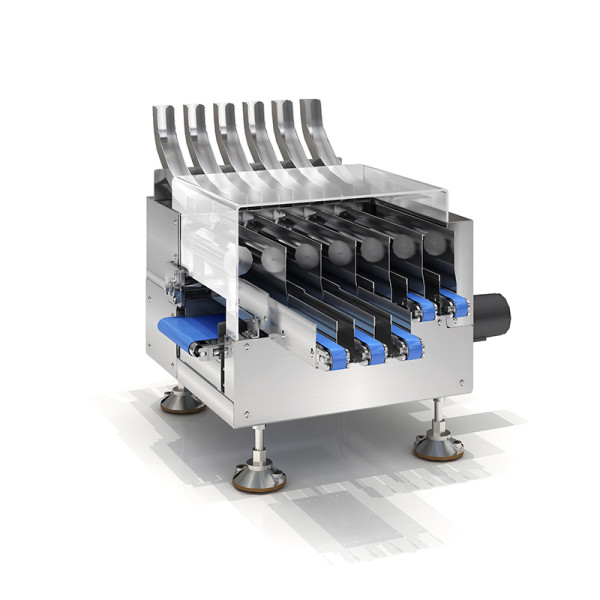
SCP6 is a Multi-lane checkweigher system for small packages. it supports multi-lane control, fast data export and compliances.